How to Tailor Your Resume to a Job Description (2026 Guide)
September 30, 2026 · Updated September 30, 2026
To tailor your resume to a job description, pull the 5 to 8 requirements the posting repeats most, then make sure each one appears in your resume as a real result from your own work, using the employer's exact wording where it is true. Reorder your bullets so the closest matches come first. Cut anything that does not support this role.
What an ATS actually does with your resume
Almost every large employer uses one. Jobscan's 2026 report found an applicant tracking system at 97.4% of Fortune 500 companies (published 20 August 2026).
Most of them do not throw your resume away automatically, though. The claim that "75% of resumes are rejected by bots" has no solid source. The career tools company Enhancv traced it to an unsourced 2012 sales pitch. In its survey of 25 US recruiters, published 1 September 2026, 23 of the 25 said their ATS does not auto-reject resumes. That is a small sample, but it matches how recruiters describe their work: the ATS stores and sorts applications, and a person searches and reads them.
So you are not writing for a robot. You are writing for a recruiter who searches the ATS for the job's key terms, then skims your resume for a few seconds. Tailoring helps you pass both steps.
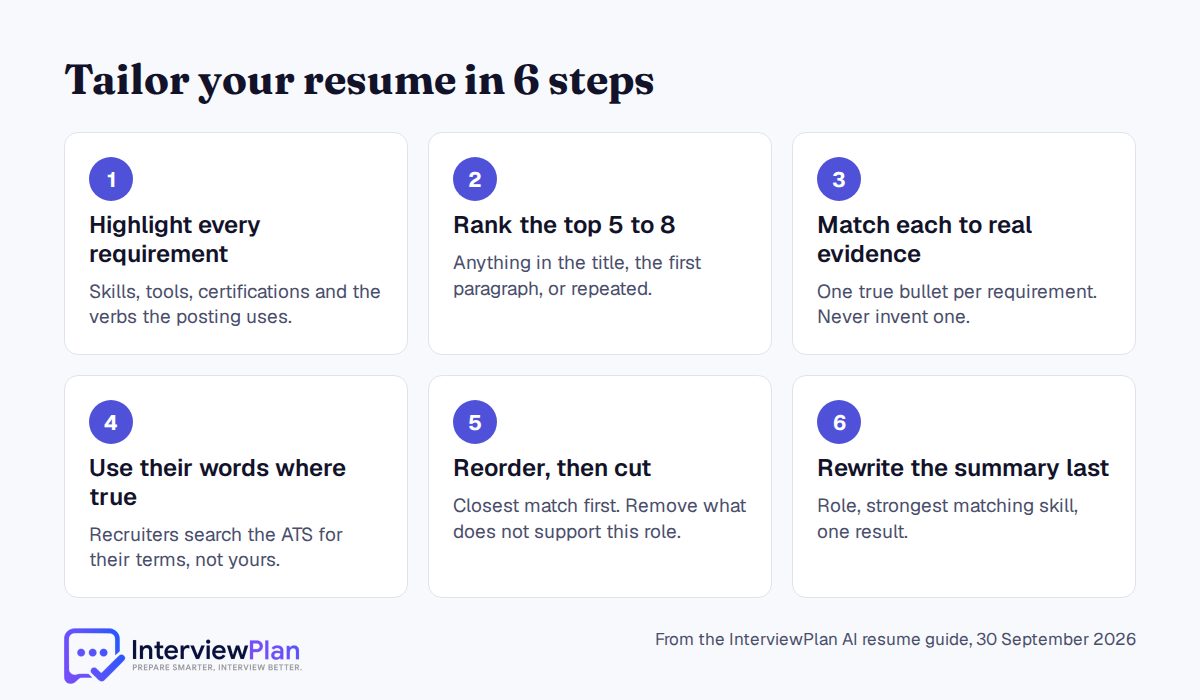
The 6-step method
Copy the job description into a document and highlight every requirement. Skills, tools, certifications, years of experience, and the verbs the posting uses for the work itself.
Rank what you highlighted. The requirements that appear in the title, the first paragraph, or more than once are the ones the recruiter will search for. Pick the top 5 to 8.
Match each one to real evidence. For every top requirement, find the bullet that proves you have done it. If you have none, do not invent one. Either leave the gap or address it honestly in your summary.
Use their words where they are true. If the posting says "stakeholder management" and your resume says "worked with business teams", change it. The recruiter searches for their term, not yours.
Reorder, then cut. Put the closest match first in each role. Remove bullets that do not support this job, even good ones. A focused resume that fits the role is easier to read than a complete one that fits every role.
Rewrite your summary last. Two or three lines that name the role, your strongest matching skill, and one result.
Keyword stuffing: why it backfires
Pasting the job description in white text, or listing every keyword in a block at the bottom, may get you surfaced in a search. It will not survive the human who reads it next, and many recruiters treat it as a reason to reject. Every keyword should sit inside a sentence that describes real work.
A before and after
Job description asks for: "Experience building dashboards in Power BI for senior stakeholders."
Before: "Created reports for the business using various BI tools."
After: "Built Power BI dashboards for the finance leadership team, replacing a weekly manual Excel report."
The second version uses the employer's tool name and audience, and describes something specific. It contains no number, and it does not need one. Add a figure only if you have a real, defensible one.
How long tailoring should take
For a role you really want, plan on [TIME ESTIMATE FROM YOUR OWN USER DATA, OR DELETE THIS LINE] per application. The first one is slowest. After that, you are adjusting a strong base resume rather than starting over.
Using AI to do this faster
AI tools can do steps 1, 2 and 4 in seconds. The risk is that they also rewrite your experience into things you did not do. That is why the InterviewPlan AI Resume Builder reads your resume against the specific job post and proposes each edit separately, so you accept or reject every change. Whatever tool you use, read every line before you send it. You will be asked about it in the interview.
Frequently asked questions
Should I tailor my resume for every job? For jobs you really want, yes. For quick applications, tailor at least the summary and the order of your bullets.
Do ATS systems reject resumes automatically? Most do not. In Enhancv's survey of 25 US recruiters (1 September 2026), 23 said their ATS does not auto-reject resumes. Some employers do set knockout questions, such as work authorization, so answer those carefully.
Is it okay to copy phrases from the job description? Yes, where the phrase is true of your experience. Using the employer's terms helps a recruiter find and recognize your fit. Copying requirements you do not meet is misrepresentation.
What file format should I use? Follow the application instructions. When none are given, a simple single-column PDF or Word file with standard section headings is the safest choice.
Sources: Jobscan, 2026 Fortune 500 ATS report, 20 August 2026; Enhancv recruiter survey via TechRSeries, 1 September 2026.