How to Answer “What Are Your Salary Expectations?” in 2026
September 3, 2026 · Updated September 3, 2026
“What are your salary expectations?”
A strong answer should be based on the market value of the role, your experience, location, responsibilities, and the overall compensation package—not a random number or simply your previous salary.
If you do not yet have enough information, ask for the employer's budgeted range. If you are expected to answer, give a researched and defensible range while remaining open to discussing the complete compensation package.
The goal is not to avoid the question.
It is to answer it without accidentally underselling yourself.
Why Do Employers Ask About Salary Expectations?
An employer usually asks about compensation for a practical reason: they need to know whether your expectations and their hiring budget are reasonably aligned.
Your response can also show whether you have researched the role and understand your current market value.
But salary conversations create an unusual interview challenge.
Most interview questions ask you to demonstrate your experience.
This one asks you to put a number on it.
That is why preparation matters.
Do not try to invent your salary expectations while sitting in the interview.
Research them beforehand.
What Is the Best Answer to “What Are Your Salary Expectations?”
A useful structure is:
Context → Range → Flexibility
For example:
“Based on the responsibilities of the position and the market rates I've researched for similar roles, I'm targeting a base salary in the $95,000 to $110,000 range. I'm also open to discussing the overall compensation package and learning more about the scope of the role.”
This works because the answer does three things.
Context: You show that your number is based on research.
Range: You give the employer useful information without locking yourself into one exact number.
Flexibility: You leave room to discuss bonuses, equity, benefits, responsibilities, and other parts of the offer.
Your exact wording should still sound natural to you.
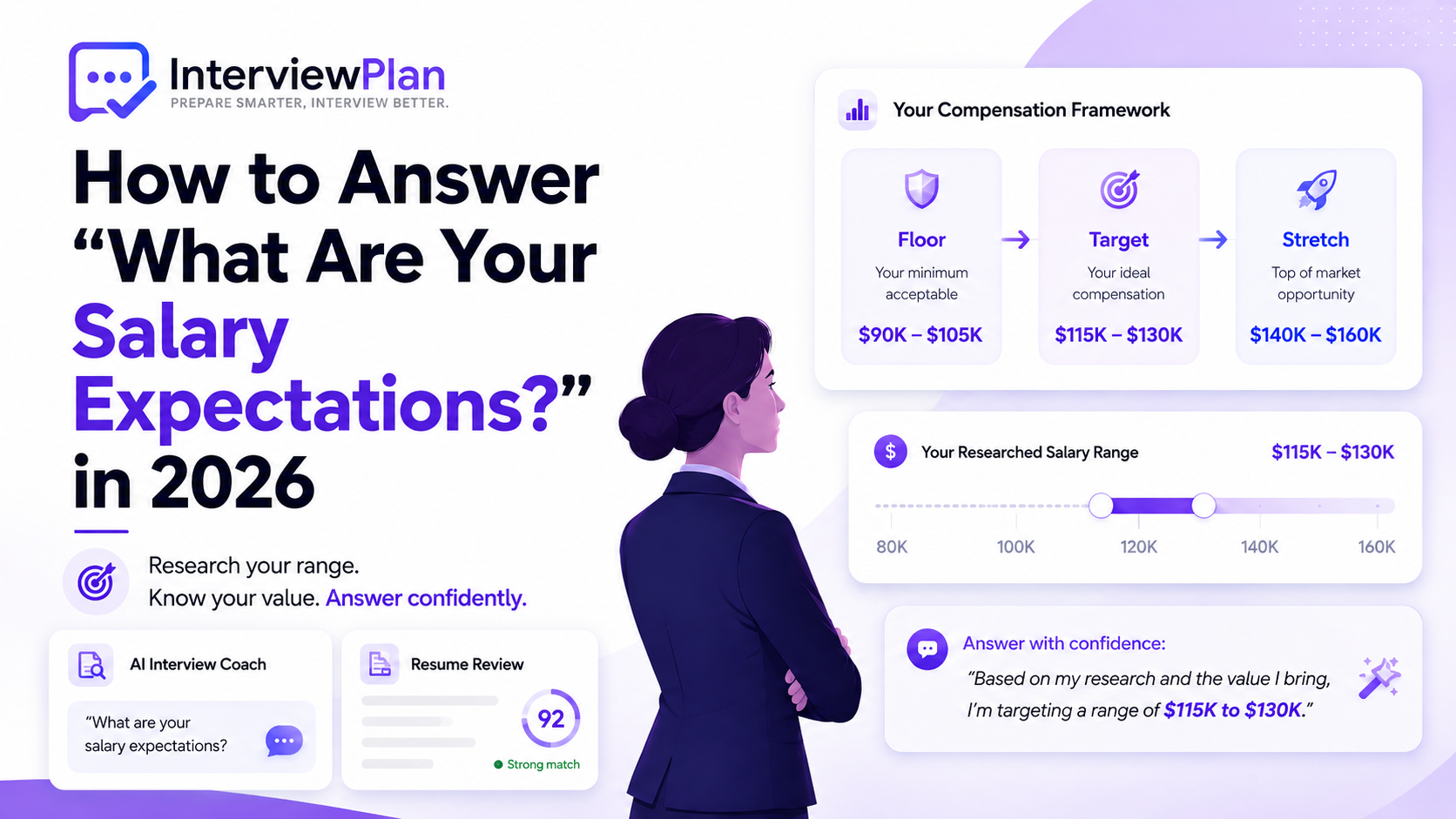
Build Your Three-Number Salary Map Before the Interview
Before deciding what range to tell a recruiter, identify three different numbers.
1. Your Private Floor
This is the lowest compensation you would realistically accept for the opportunity after considering factors such as:
living costs
commute or relocation
benefits
bonus structure
equity
job stability
responsibilities
career growth
competing opportunities
The important word is private.
Your minimum acceptable salary is useful for your own decision-making, but it does not automatically need to become the bottom of the range you give an employer.
2. Your Target
This is the compensation you believe represents a fair outcome based on the position, your experience, the market, and your qualifications.
For example:
Private floor: $85,000
Target: $100,000
Stretch: $115,000
You might therefore discuss a range around $100,000–$115,000, rather than immediately telling the recruiter that you would accept $85,000.
Your floor helps you make a decision.
Your target helps you negotiate.
3. Your Stretch Number
Your stretch number is an ambitious but defensible outcome.
It should not be a random dream salary.
You should be able to explain why it makes sense based on factors such as specialised skills, relevant industry experience, leadership responsibilities, market conditions, certifications, technical expertise, or unusually strong alignment with the position.
Think:
Private Floor → Target → Stretch
Know all three before the interview.
But do not assume you need to disclose all three.
How Should You Research Your Salary Range?
A strong salary answer begins with evidence.
For US roles, start with several sources instead of trusting a single number.
Check the Job Posting
If the employer publishes a compensation range, it should be one of your strongest reference points.
Look carefully at whether the range refers to:
base salary
total cash compensation
hourly compensation
estimated earnings
commission-inclusive earnings
total compensation
These are not interchangeable.
Check Government Wage Data
The US Bureau of Labor Statistics Occupational Employment and Wage Statistics program provides wage estimates for hundreds of occupations across national, state, and local markets.
It can provide a useful neutral benchmark.
However, broad occupational averages will not perfectly account for company size, specialized skills, seniority, equity, bonuses, or an individual employer's compensation philosophy.
Use the information as one input rather than treating it as the exact answer.
Compare Similar Job Openings
Search for similar positions with comparable:
titles
seniority
responsibilities
industries
locations
technical requirements
A “Product Manager” at a small regional business and a “Product Manager” at a large technology company may have dramatically different compensation structures despite having similar titles.
Compare the actual work, not only the title.
Use Multiple Salary Platforms
Salary databases and employer-review sites can provide another reference point.
Compare several sources.
If five sources give you five different answers, investigate why.
Differences may come from geography, seniority, bonus treatment, company type, or outdated data.
Talk to People in the Market
Recruiters, colleagues, industry peers, hiring managers, and professional communities can provide context that a database may miss.
A useful question is:
“What range are you currently seeing for someone with my experience interviewing for this type of role?”
The more sources you compare, the easier it becomes to identify a defensible target.
Should You Give a Number First?
Not always.
The best response depends on how much information you have.
If the Employer Has Not Shared a Salary Range
You can ask:
“I'm definitely open to discussing compensation. Could you share the budgeted range for the role so I can make sure we're aligned?”
That is a legitimate information-gathering question.
If the recruiter provides a range, you can then respond based on where your expectations fall within it.
If the Employer Has Already Published a Range
Do not pretend you have not seen it.
Instead, reference it directly.
For example:
“I saw that the position is listed at $110,000 to $135,000. Based on my experience leading similar projects, I'd be targeting the upper half of that range, although I'd like to consider the complete compensation package as well.”
This is much stronger than giving a completely unrelated range.
If the Recruiter Insists on a Number
Give your researched range confidently.
Do not apologise for it.
Do not turn the response into a five-minute explanation.
For example:
“Based on the role and comparable positions I've researched, I'm targeting $120,000 to $135,000 in base compensation. I'm flexible depending on the full package and responsibilities.”
Then stop.
Give the interviewer space to respond.
10 Salary Expectations Answer Examples
There is no single perfect script. Your answer should reflect the stage of the interview and the information available.
Example 1: Early Recruiter Screen
“I'm open to discussing compensation, but I'd like to make sure we're evaluating the same scope first. Could you share the budgeted salary range for the position?”
Example 2: When a Salary Range Is Already Posted
“I saw the published range of $90,000 to $110,000. Based on the responsibilities and my experience, that range is generally aligned with what I'm considering. I'd be happy to discuss where within the range makes sense based on the complete package.”
Example 3: When You Are Asked for a Specific Range
“Based on my research and experience, I'm targeting approximately $100,000 to $115,000 in base salary. I'm also considering the overall package, so I'm open to discussing the details.”
Example 4: Entry-Level Candidate
“My priority is finding a role where I can build strong experience and contribute quickly. Based on entry-level salaries I've researched for this position and location, I'm targeting around $60,000 to $68,000, although I'm open to discussing the full package.”
Being early in your career does not mean you should answer:
“Anything is fine.”
Research still matters.
Example 5: Experienced Software Engineer
“For positions with this level of engineering ownership, I'm currently targeting a base salary between $160,000 and $180,000. I'd also want to understand the equity, bonus structure, and overall responsibilities before evaluating the full offer.”
Example 6: Manager or Leadership Candidate
“Based on the scope we've discussed, including team leadership and ownership of the function, I'd expect a base salary around $145,000 to $165,000. I'm flexible depending on the performance incentives and overall compensation structure.”
Example 7: Career Changer
“Although I'm moving into a new function, I'm bringing several years of directly transferable experience in analytics and operations. Based on comparable roles I've researched, I'm targeting $80,000 to $90,000, while remaining open to the overall package.”
Do not automatically discount all of your previous experience simply because your title is changing.
Example 8: Remote Position
“I've researched comparable positions based on the responsibilities and level of the role rather than relying on one geographic benchmark. I'm targeting $105,000 to $120,000, but I'm open to discussing how your company structures compensation for remote employees.”
Example 9: When Total Compensation Matters
“For base salary, I'm targeting around $125,000 to $140,000. That said, I'd want to consider the complete compensation package, including bonus, equity, benefits, and the scope of the role.”
This prevents confusion between base salary and total compensation.
Example 10: When You Need More Information
“I have a range in mind, but I'd like to understand the responsibilities and expectations a little better before giving you a precise number. Could you share the range budgeted for the position?”
This is different from refusing to answer.
You are explaining why additional information would help you answer accurately.
What Should You Put for Salary Expectations on a Job Application?
Application forms can be more difficult because a text box cannot negotiate with you.
First, check whether the salary range is already included in the job posting.
If the field accepts text, depending on the form, you may be able to write something such as:
“Negotiable based on responsibilities and total compensation.”
If the application requires a numeric value, use your market research and target compensation rather than entering a random number.
Before submitting, make sure you understand whether the application is asking for:
annual salary
hourly pay
base salary
total compensation
Do not assume they mean the same thing.
Should You Tell an Employer Your Current Salary?
Your current compensation and the value of the new position are separate questions.
A professional redirect can be:
“I'd prefer to focus on the responsibilities and market value of this position. For this opportunity, I'm targeting around $110,000 to $125,000.”
This keeps the conversation focused on what the new role is worth rather than simply using your previous compensation as the starting point.
What If Your Expected Salary Is Above Their Range?
Do not panic immediately.
First, understand how far apart the numbers are.
If you want $130,000 and their maximum is $125,000, the complete compensation package may still be worth discussing.
If you want $150,000 and their maximum is $95,000, you probably have a larger alignment problem.
You can respond professionally:
“Thank you for being transparent. My target is closer to $135,000 based on the scope and my experience. Is there flexibility in the base salary or broader compensation package?”
Their answer gives you useful information.
Remember that an interview is not only about convincing the employer to choose you.
You are also evaluating whether the opportunity makes sense for you.
7 Salary Expectation Mistakes to Avoid
1. Saying “Anything Is Fine”
Flexibility sounds positive, but having no position at all can make you appear unprepared.
Know your market.
2. Giving a Random Number
Your expectations should have a reason behind them.
Research before the interview.
3. Revealing Your Minimum Too Quickly
Your private floor exists to help you make decisions.
It does not have to become your opening negotiation position.
4. Using an Extremely Wide Range
Saying:
“Somewhere between $80,000 and $150,000”
does not communicate a meaningful expectation.
Your range should reflect realistic market research.
5. Forgetting About Total Compensation
Base salary is only one element of some compensation packages.
Depending on the position, you may also need to evaluate:
annual bonus
commission
equity
retirement benefits
health benefits
paid time off
signing bonus
relocation support
remote-work policies
Compare the complete opportunity.
6. Apologizing for Your Number
Avoid:
“I know this is probably too much, but…”
State your researched expectation professionally.
7. Memorising a Script Word for Word
You need a strategy, not a speech.
Learn your numbers and your reasoning.
Then practice communicating them naturally.
A 5-Minute Salary Expectations Preparation Checklist
Before your next interview, answer these questions:
What is the employer's published range?
If none is published, research comparable positions.
What is my private floor?
Know the point below which the opportunity no longer makes sense.
What is my target?
Determine the compensation you would consider a fair outcome.
What is my stretch number?
Identify an ambitious but defensible upper target.
Am I discussing base salary or total compensation?
Clarify the difference.
What will I say if asked for a range?
Practice one concise answer.
What will I say if asked earlier than expected?
Prepare a polite question about the employer's budgeted range.
If you can answer all seven before the interview, the salary question becomes much easier.
How Can AI Help You Prepare for Salary Questions?
AI is most useful here as a preparation partner—not as a substitute for researching your actual market value.
A practical workflow is:
Review the job description.
Identify the responsibilities and seniority.
Research current compensation independently.
Decide your private floor, target, and stretch.
Draft your salary-expectation answer.
Practice different recruiter follow-up questions.
Refine your delivery until it sounds natural.
InterviewPlan.AI can help you practice interview questions using your resume and job context so that you can prepare for different ways an interviewer might raise compensation, experience, strengths, or role fit.
The goal is not to memorise perfect sentences.
It is to know your position well enough that you can answer confidently when the wording changes.
Frequently Asked Questions
What is the best answer for salary expectations?
The best answer is a researched salary range based on the role, location, responsibilities, experience, and overall compensation package. If you do not yet have enough information, ask the employer for the budgeted range before committing to a specific number.
Is it better to give a salary range or one number?
A reasonable range usually gives you more flexibility than one exact figure. The range should still be narrow enough to communicate a meaningful expectation and should be supported by market research.
How wide should my salary range be?
There is no universal rule. The range should reflect realistic compensation outcomes for the specific position rather than an arbitrary percentage. Avoid ranges so wide that they provide no useful information.
What if the salary range is lower than I expected?
Ask whether there is flexibility and evaluate the complete compensation package. If the gap is substantial and the employer cannot move, the role may simply not meet your compensation requirements.
Should I say I'm negotiable?
You can communicate flexibility, but combine it with a clear position. “I'm flexible” is more useful after you have established either your researched range or the employer's budget.
What should I say if I don't know the market salary?
Research before the interview. Review the job posting, comparable openings, government wage data, salary databases, and conversations with people in the market.
Should I give my lowest acceptable salary?
Usually, your lowest acceptable number is more useful as a private decision-making threshold than as your opening negotiating position.
Your Salary Answer Should Be Prepared Before the Interview
“What are your salary expectations?” becomes difficult when you try to calculate your value in real time.
Instead, enter the interview knowing three numbers:
Private Floor → Target → Stretch
Research the position.
Understand the compensation structure.
Prepare your range.
Practice how you will explain it.
Then focus on having a professional conversation rather than finding a magical number that guarantees the job.
Want to practice before the real interview?
Use InterviewPlan.AI to prepare with your resume and job description, practice realistic interview questions, and refine your answers until they sound clear, relevant, and natural.
Think better. Answer confidently. Stay human.