Your Rights When AI Screens Your Job Application (2026)
October 2, 2026 · Updated October 2, 2026
If an employer uses AI to screen you, you may have the right to be told, to have it explained, to ask for a human review, or to have your interview video deleted. Which rights you get depends on where the job is, and New York City, Illinois, California, Colorado, Ontario and the EU each differ.
Most articles about AI hiring laws are written for employers. This one is for you. It covers what each law lets you ask for, as of 1 October 2026, and a short email you can send to any recruiter.
This is general information, not legal advice. Laws change, and how they apply depends on the employer, the role and where you are.
What counts as AI screening
AI screening is any automated tool that ranks, scores or filters candidates. Common examples are resume ranking in an applicant tracking system, one-way video interviews scored by software, chatbot screening questions, and AI-run first-round interviews. You often will not be told it is happening unless a law requires it. That is why the rules below matter.
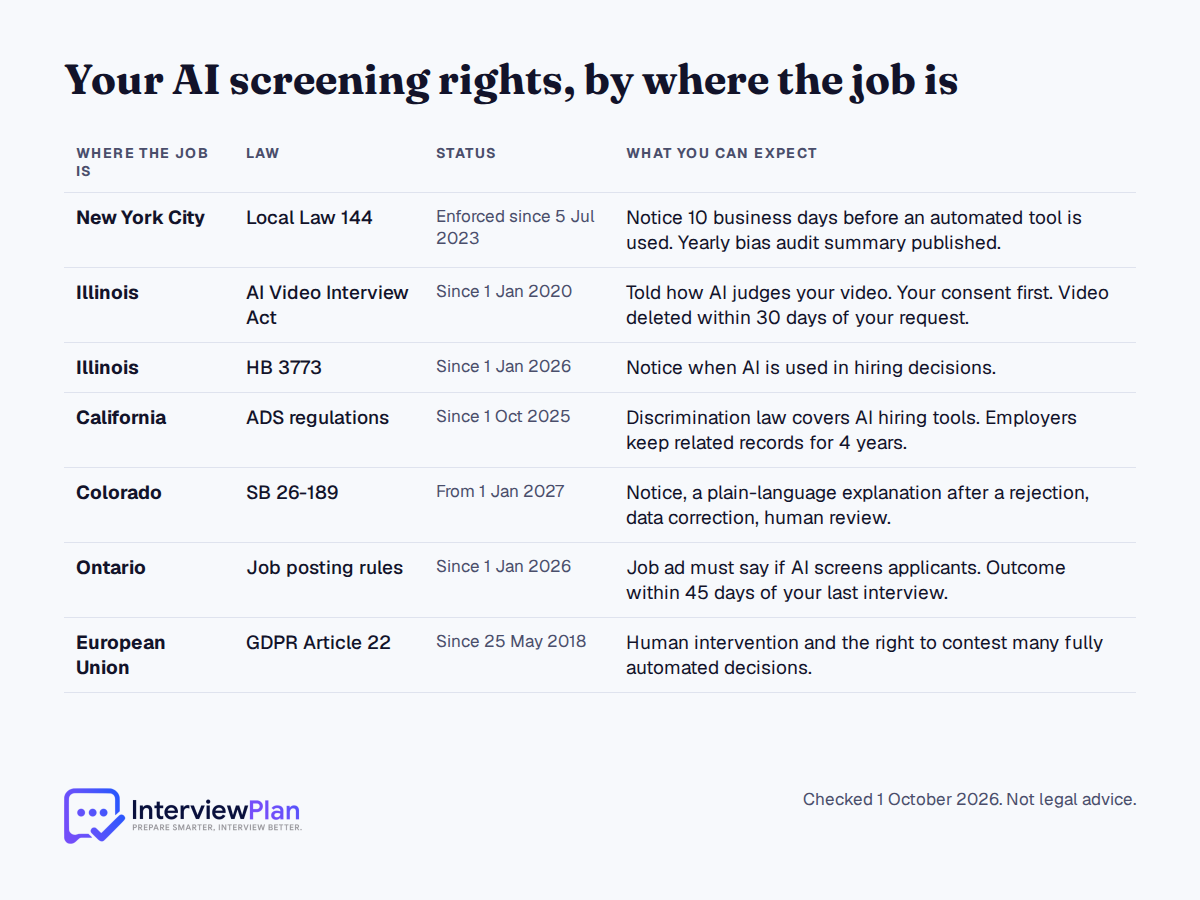
Your rights, by where the job is
Where the job is | Law | Status | What you can expect |
|---|---|---|---|
New York City | Local Law 144 | Enforced since 5 July 2023 | Notice at least 10 business days before an automated tool is used, a description of what it assesses, a yearly bias audit summary published by the employer, and instructions to request an accommodation |
Illinois | AI Video Interview Act | In force since 1 January 2020 | Before AI analyzes your video interview: notice, an explanation of how it works and what it evaluates, and your consent. Your video deleted within 30 days of your request |
Illinois | HB 3773 | In force since 1 January 2026 | Notice when AI is used in hiring and other employment decisions |
California | Civil Rights Council regulations on automated decision systems | In force since 1 October 2025 | Anti-discrimination law explicitly covers AI hiring tools, and employers must keep related records for 4 years |
Colorado | SB 26-189 | Signed 14 May 2026, applies from 1 January 2027 | Notice before use, a plain-language explanation after an adverse decision, a chance to correct inaccurate data, and a request for human review |
Ontario | Employment Standards Act job posting rules | In force since 1 January 2026 for employers with 25 or more staff | The job ad must say if AI screens, assesses or selects applicants. You must be told the outcome within 45 days of your last interview |
European Union | GDPR Article 22 | In force since 25 May 2018 | For many decisions made solely by automated means, the right to human intervention, to give your view and to contest the decision |
European Union | AI Act | Hiring rules apply from 2 December 2027 | The Digital Omnibus, in force since 27 July 2026, moved the high-risk rules for hiring tools from August 2026 to December 2027 |
Three things these laws have in common
You have a right to know. New York City, Illinois, Colorado and Ontario all require some form of notice. If a job is covered and you were not told, that is worth asking about.
A person can step in. Colorado from 2027, and the EU through the GDPR, give you a route to human review. Elsewhere there is no legal right yet, but you can still ask.
Your data can be corrected or deleted. Illinois lets you have your video interview deleted. Colorado will let you correct inaccurate data that fed a decision.
How to ask
You do not need to sound like a lawyer. A short, friendly email to the recruiter works best, ideally before the screening step.

Subject: Question about the screening process
Hi [Name], thank you for moving my application forward. Before the next step, could you tell me:
Is an AI or automated tool used to screen or score candidates for this role?
If so, what does it assess?
Can I request a review by a person, or an alternative process if I need an accommodation?
Thanks, [Your name]
It is a reasonable, professional question. In New York City and Ontario, the employer is already required to tell you part of this.
If you think an AI screened you out unfairly
Ask for the reason. In Colorado from 2027 you will be entitled to a plain-language explanation. Anywhere else, a polite request often gets an answer.
Ask for a human review. Name the specific experience the tool may have missed.
Request deletion where you can. In Illinois, ask for your video interview to be deleted within 30 days.
Keep a record. Save the job ad, the dates and any notice you received.
Get advice if it matters. If you believe you were screened out because of a protected characteristic such as age, disability or race, talk to an employment lawyer or your local civil rights agency.
How to prepare for AI screening
The best defence is a resume and interview answers that make your fit easy to see. Use the employer's words where they are true, and put your closest-matching experience first. Our guide to tailoring your resume to a job description shows how. Practice structured answers with mock interviews before any recorded or AI-run round. And if you are wondering whether you can use AI yourself in the interview, read Is Using an AI Interview Copilot Cheating? first.
Frequently asked questions
Do employers have to tell me if AI screens my application? In some places, yes. New York City requires notice at least 10 business days before an automated tool is used. Illinois requires notice under HB 3773 and, for video interviews, under the AI Video Interview Act. Ontario job ads from employers with 25 or more staff must say if AI is used. Colorado will require notice from 1 January 2027.
Can I ask for a human to review my application instead of AI? You can always ask. Colorado will give applicants a right to request human review from 1 January 2027. In the EU, GDPR Article 22 gives a right to human intervention for many decisions made solely by automated means.
Can I make an employer delete my AI-analyzed video interview? In Illinois, yes. Under the AI Video Interview Act, the employer must delete it, including copies held by vendors, within 30 days of your request.
Does the EU AI Act protect job applicants yet? Not the hiring-specific parts. The Digital Omnibus moved the high-risk rules that cover recruitment tools to 2 December 2027. The GDPR already applies today.
Does any of this apply to jobs in India? None of these laws applies to a job based only in India. If you apply from India to a role in New York City, Illinois, Colorado, Ontario or the EU, the rules for that location may still apply. Check with the employer.
Sources
NYC Department of Consumer and Worker Protection, Automated Employment Decision Tools FAQ
Holistic AI, Illinois Artificial Intelligence Video Interview Act
Seyfarth Shaw, California and Illinois AI rules, 12 September 2025
Holland & Knight, Colorado Governor Signs SB 189, 18 May 2026
Hunton Andrews Kurth, EU Digital Omnibus on AI enters into force, 28 July 2026