10 Common Interview Questions & Best Answers (2026)
September 1, 2026 · Updated September 25, 2026
Job interviews can feel unpredictable.
But many interviews are built around a surprisingly familiar group of questions.
You may be asked about your experience, strengths, weaknesses, motivation, career goals, accomplishments, failures, or why you want the position.
The exact wording changes.
The purpose usually does not.
Interviewers are trying to understand:
Who you are professionally
Whether you can perform the job
How you think and communicate
Why you want the opportunity
How you respond to difficult situations
Whether you are likely to succeed within their team
The best way to prepare is not to memorise perfect answers.
Instead, understand what the interviewer is trying to learn and prepare a clear structure you can adapt naturally.
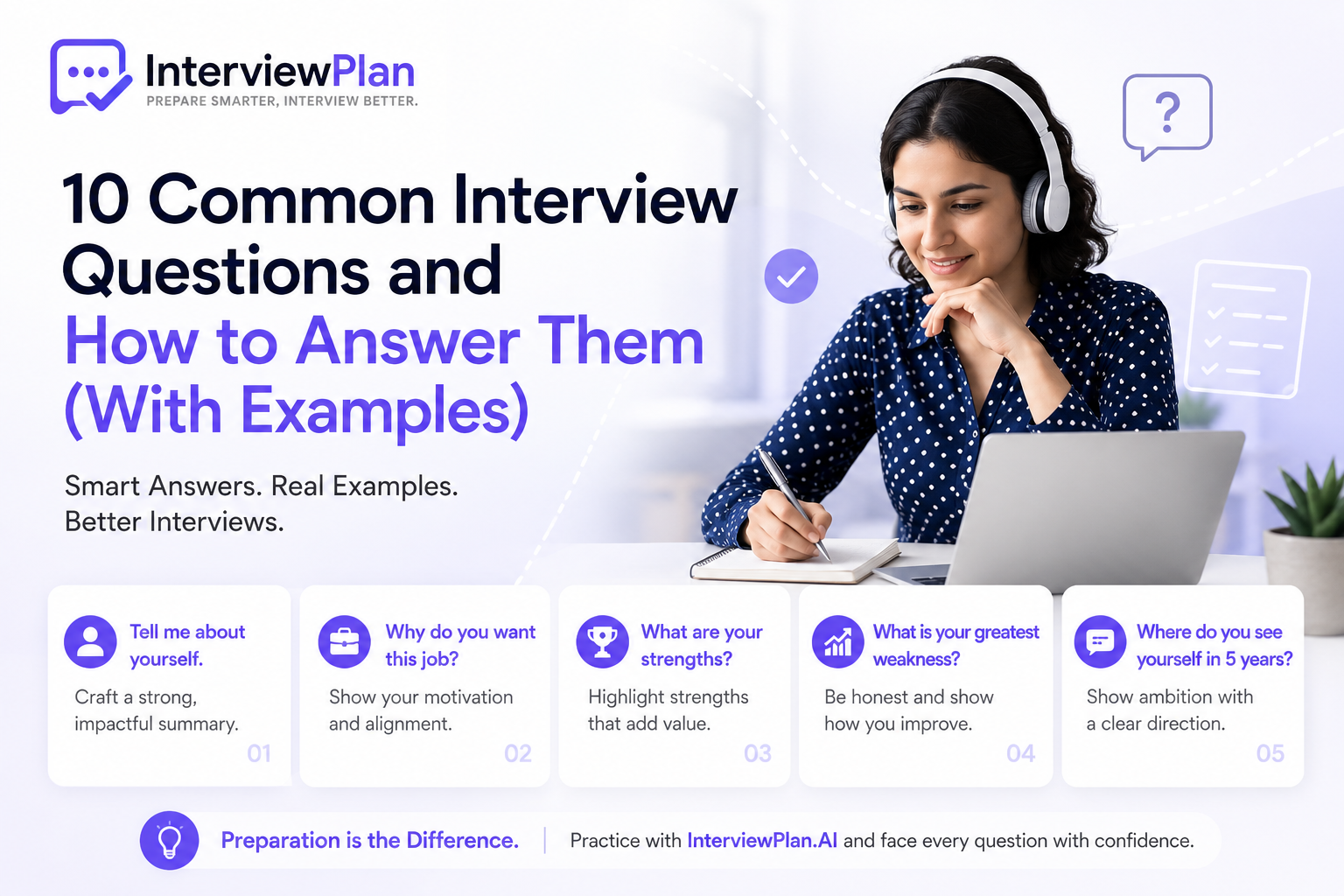
Here are 10 of the most common interview questions, what interviewers are looking for, and examples of how to answer them effectively.
Quick Answer: What Are the Most Common Interview Questions?
The most common job interview questions include:
Tell me about yourself.
Why do you want this job?
Why do you want to work for our company?
What are your greatest strengths?
What is your greatest weakness?
Why are you leaving your current job?
Tell me about a challenge you faced.
What is your greatest professional achievement?
Where do you see yourself in five years?
Why should we hire you?
Preparing a flexible framework for these questions can help you respond more confidently even when the interviewer phrases them differently.
1. “Tell Me About Yourself”
This is often one of the first questions in an interview.
And it is not an invitation to tell your entire life story.
The interviewer wants a concise professional introduction that explains:
Who you are → What you have done → What you are looking for next
A useful framework is:
Present → Past → Future
Present
Explain what you currently do or your strongest professional identity.
Past
Mention relevant experience, achievements, or skills.
Future
Connect your background with the opportunity you are interviewing for.
Example Answer
“I'm a digital marketing professional with around four years of experience managing performance campaigns and content strategies for B2B technology companies.
In my current role, I've worked across paid advertising, SEO, and lead-generation campaigns while collaborating closely with sales and design teams.
Over time, I've become particularly interested in building data-driven growth strategies, which is why this opportunity stood out to me. I'm looking for a role where I can take greater ownership of campaign strategy while continuing to develop my analytical skills.”
Avoid
Do not begin with:
“My name is John. I was born in…”
Unless personal information directly matters to the role, stay professionally focused.
2. “Why Do You Want This Job?”
Interviewers ask this because they want to know whether you genuinely understand the position.
Your answer should connect three things:
The Role + Your Skills + Your Career Direction
A weak answer focuses only on what you want.
“I want better opportunities.”
A stronger answer explains why the responsibilities align with your experience and goals.
Example Answer
“What interests me most about this position is the combination of customer research, campaign strategy, and performance analysis. Those are areas I've already worked in and genuinely enjoy.
I'm also looking for a position where I can take more ownership of strategy rather than focusing only on execution, so the responsibilities described in this role align very closely with where I want to develop next.”
Interview Tip
Read the job description before your interview and identify the three most important responsibilities.
Your answer should reference at least one of them.
3. “Why Do You Want to Work Here?”
This question is different from:
“Why do you want this job?”
One focuses on the role.
The other focuses on the organization.
A strong answer can use this simple framework:
Company → Role → Contribution
Company
Mention something genuinely interesting about the organization.
Role
Explain why the particular opportunity appeals to you.
Contribution
Show how your experience could create value.
Example Answer
“I've been following the way your company is expanding its product offering, particularly your focus on making the platform easier for smaller businesses to adopt.
This position interests me because it combines product marketing with customer research, which are both areas I've worked in.
I think my experience translating customer insights into campaigns could help the team communicate the product's value more clearly as the company continues growing.”
Avoid
Generic statements such as:
“Your company is very famous and I would love to work here.”
The answer should sound specific enough that it could not be given to every company you interview with.
4. “What Are Your Greatest Strengths?”
The interviewer does not need a list of ten positive adjectives.
Choose one or two strengths that matter for the job and support them with evidence.
Use:
Strength → Evidence → Relevance
Example Answer
“One of my biggest strengths is simplifying complicated information.
In my current role, I frequently work between technical and non-technical stakeholders. For one recent project, I converted a complex set of technical requirements into a clearer process document that helped the business and development teams reach agreement much faster.
I think that ability would be useful in this role because stakeholder communication appears to be a major part of the position.”
This is stronger than simply saying:
“I'm a good communicator.”
Evidence makes your strength believable.
5. “What Is Your Greatest Weakness?”
This question makes many candidates uncomfortable because they think they need to disguise a strength as a weakness.
For example:
“I work too hard.”
Interviewers have heard versions of this many times.
Instead, choose a real but manageable weakness and demonstrate improvement.
Use:
Weakness → Awareness → Improvement
Example Answer
“Earlier in my career, I sometimes spent too much time trying to solve problems independently before asking for input.
I realised that while independence is useful, waiting too long can slow a project down.
I've become much more deliberate about setting a time limit for myself. If I'm still blocked after investigating the problem, I'll involve the appropriate person rather than continuing alone.”
The interviewer should hear two things:
Self-awareness and progress.
6. “Why Are You Leaving Your Current Job?”
Keep this answer professional.
You do not need to pretend everything is perfect in your current position.
But attacking your manager, coworkers, or employer usually works against you.
Focus on what you are moving toward rather than what you are escaping.
Example Answer
“I've learned a lot in my current position, and I'm grateful for the experience. At this stage, I'm looking for a role where I can take greater ownership of projects and work more closely with strategic decision-making.
When I reviewed this opportunity, that combination of responsibility and growth was one of the main reasons I wanted to explore it.”
If You Were Laid Off
Be clear and concise.
“My position was impacted as part of a broader restructuring. Since then, I've been focused on finding a role where my experience in customer analytics and product strategy would be particularly valuable.”
You do not need to become defensive.
7. “Tell Me About a Challenge You Faced”
This is a behavioral interview question.
The interviewer wants evidence from something you have actually experienced.
A useful structure is the STAR method:
S — Situation
What was happening?
T — Task
What were you responsible for?
A — Action
What specifically did you do?
R — Result
What happened because of your actions?
Example Answer
“In my previous role, we were preparing to launch a client campaign when we discovered that several important assets would not be ready by the original launch date.
I was responsible for coordinating the campaign timeline, so I worked with the creative and client teams to identify which assets were essential for launch and which could be introduced later.
We reorganised the production schedule, prioritised the highest-impact materials, and communicated the revised timeline clearly to the client.
As a result, we launched on the agreed date without compromising the core campaign, and the remaining assets were added during the following week.”
Notice how most of the answer focuses on Action and Result.
That is usually where the strongest evidence is.
8. “What Is Your Greatest Professional Achievement?”
Choose an achievement that demonstrates skills relevant to the position.
Then explain:
Problem → Action → Impact
Numbers help when you genuinely have them.
Example Answer
“One achievement I'm particularly proud of was improving our lead-generation process for a B2B campaign.
We were generating traffic, but too few visitors were converting into qualified leads. I analyzed the landing-page journey and noticed that we were asking prospects for too much information too early.
I worked with the marketing and design teams to simplify the page and shorten the form.
Over the following two months, the landing-page conversion rate increased significantly and the sales team received a higher volume of qualified inquiries.”
If you know the verified number, include it:
“Conversion improved from 3.8% to 5.6%.”
Specific results make achievements easier to understand.
Never invent numbers just because you think an interview answer needs them.
9. “Where Do You See Yourself in Five Years?”
Interviewers are not asking you to predict the future perfectly.
They want to understand whether your direction makes sense alongside the opportunity.
A strong answer demonstrates:
Ambition
Realism
Skill development
Connection to the role
Example Answer
“Over the next several years, I'd like to become someone who can independently own larger product initiatives and eventually mentor more junior members of the team.
In the short term, my priority is strengthening my product strategy and stakeholder-management skills while delivering strong results in the role.
That's one reason this opportunity interests me—the position appears to offer room to build exactly those capabilities.”
Avoid making the interviewer feel that the current position is simply something you intend to leave immediately.
10. “Why Should We Hire You?”
This is your opportunity to connect the interview.
Do not answer:
“Because I'm hardworking.”
Most candidates will say something similar.
Instead, bring together:
Experience + Evidence + Fit
Example Answer
“I think there are three areas where my background aligns particularly well with what you're looking for.
First, I already have experience managing performance marketing campaigns across multiple channels.
Second, I've worked closely with sales teams, so I'm comfortable connecting marketing activity with actual pipeline outcomes.
And third, the role requires someone who can both analyse performance and communicate recommendations clearly, which has been a major part of my current position.
I believe that combination would allow me to start contributing relatively quickly while continuing to grow into the broader responsibilities of the position.”
You are not claiming to be the perfect candidate.
You are helping the interviewer understand why your experience matches their problem.
How Long Should Interview Answers Be?
There is no universal perfect length.
But for most standard interview questions:
Simple introductory questions
Approximately 30–90 seconds
Behavioral questions
Approximately 1–2 minutes
Complex technical or strategic questions
Potentially longer when the interviewer wants more detail.
A useful rule is:
Answer the question clearly, give enough evidence, and stop.
Do not keep talking simply because the interviewer has not interrupted you.
How to Answer Interview Questions When You Don't Know the Answer
You will occasionally receive a question you did not prepare for.
That is normal.
Instead of immediately filling the silence, take a moment.
You can say:
“That's a good question. Let me think about that for a moment.”
Then structure your response.
For hypothetical questions, explain your reasoning.
For technical questions, be transparent about what you know and what you would investigate.
For experience questions where you do not have an exact example, acknowledge it and provide the closest relevant situation.
Being thoughtful is often better than responding quickly with a weak answer.
How to Prepare for Interview Questions Without Memorizing Answers
Memorization often creates a new problem.
The candidate becomes so focused on remembering the script that the conversation stops sounding natural.
Instead, prepare answer points.
For every important interview question, write down approximately three things you want to communicate.
For example:
Tell me about yourself
Current role
Relevant accomplishment
Why this opportunity makes sense
Why do you want this job?
Responsibility that interests you
Relevant skill
Career direction
Greatest achievement
Problem
Your action
Result
You then have a structure rather than a script.
Create an Interview Story Bank
One of the most effective ways to prepare for behavioural interviews is to build a small collection of examples from your experience.
Prepare approximately 6–8 stories involving situations such as:
A difficult problem
An achievement
A disagreement
A mistake
Leadership
Teamwork
Working under pressure
Learning something quickly
One story can often answer several different interview questions.
For example, a project where you solved a difficult customer problem might help answer questions about:
Problem solving
Customer service
Initiative
Working under pressure
Communication
The wording of the question changes.
Your relevant experiences remain the same.
Questions You Should Ask the Interviewer
Interviews should not be completely one-sided.
Near the end, you will often hear:
“Do you have any questions for us?”
Avoid automatically saying:
“No, I think you covered everything.”
Prepare a few thoughtful questions.
For example:
“What would success look like during the first 90 days?”
This helps you understand expectations.
“What are the biggest challenges someone entering this position would face?”
This gives you useful context about the role.
“How does the team usually collaborate?”
This helps you understand working style.
“What distinguishes people who perform particularly well in this position?”
This can reveal what the organization genuinely values.
“What are the next steps in the interview process?”
A perfectly reasonable final question.
Common Interview Answer Mistakes
1. Memorising complete scripts
Prepare ideas rather than sentences.
2. Giving extremely long answers
Good communication includes knowing when to stop.
3. Making every answer generic
Connect your experience to the specific role.
4. Making claims without evidence
Whenever possible, support strengths with examples.
5. Speaking negatively about former employers
Keep difficult experiences professional and factual.
6. Answering what you think the interviewer wants
Your responses still need to reflect your real experience.
7. Failing to research the company
Company-specific questions become much easier when you understand the organisation beforehand.
The Simple Interview Answer Formula
If you find yourself struggling during an interview, remember this framework:
Answer → Evidence → Relevance
1. Answer
Respond directly to the question.
2. Evidence
Provide an example, experience, or explanation.
3. Relevance
Connect your answer to the position when appropriate.
For example:
Question: What is your greatest strength?
Answer:
“My strongest skill is stakeholder communication.”
Evidence:
“I regularly translate technical requirements into documentation for business teams.”
Relevance:
“Since this role works closely with both clients and technical teams, I think that ability would be particularly useful.”
Simple.
Clear.
Relevant.
How InterviewPlan.AI Helps You Prepare for Interviews
Reading interview questions is useful.
But knowing an answer and delivering it confidently under pressure are two different things.
InterviewPlan.AI is designed to help candidates prepare more intelligently using information relevant to their actual opportunity.
Instead of relying only on generic interview scripts, candidates can prepare around their:
CV
Experience
Target role
Job description
Interview context
That means your preparation can focus on the questions most relevant to your interview, rather than memorizing hundreds of generic answers.
The goal is not to replace your experience.
It is to help you communicate that experience more clearly.
Think Better. Answer Confidently. Get Hired.
Frequently Asked Questions
What are the 10 most common interview questions?
Ten commonly asked interview questions include “Tell me about yourself,” “Why do you want this job?”, “Why do you want to work here?”, questions about strengths and weaknesses, career goals, professional achievements, challenges, reasons for leaving a job, and “Why should we hire you?”
What is the best way to answer interview questions?
Answer the question directly, support your response with relevant evidence or an example, and connect it to the role when appropriate. Behavioral questions can often be structured using the STAR method.
How should I answer “Tell me about yourself”?
Use a Present–Past–Future structure. Briefly explain your current professional situation, highlight relevant experience from your past, and explain why the opportunity represents a logical next step.
How long should an interview answer be?
Many standard answers can be delivered in approximately 30–90 seconds, while behavioral answers may take one to two minutes depending on the complexity of the example.
Should I memorize interview answers?
It is usually better to memorize key points rather than entire scripts. This helps your answers remain structured while still sounding natural.
How do I prepare for behavioral interview questions?
Build a collection of professional stories involving achievements, challenges, teamwork, conflict, leadership, mistakes, and problem solving. Practice explaining them using the STAR structure: Situation, Task, Action, and Result.
What should I say if I don't know an interview answer?
Take a few seconds to think. Explain your reasoning, be transparent about gaps in your knowledge, and describe how you would approach finding the answer when appropriate.
How many questions should I prepare before an interview?
There is no fixed number, but preparing strong frameworks for the most common questions and six to eight adaptable professional stories will usually give you material that can be used across many questions.
Final Thoughts
You cannot predict every question you will receive in a job interview.
You do not need to.
Strong interview preparation is about developing a clear understanding of:
Your experience.
Your achievements.
Your strengths.
Your motivation.
And the value you can bring to the role.
Then prepare frameworks that help you communicate those ideas naturally.
Remember:
Don't memorise the perfect answer.
Prepare the right message.
Then practice delivering it with confidence.
Prepare Smarter. Interview Better.
— InterviewPlan