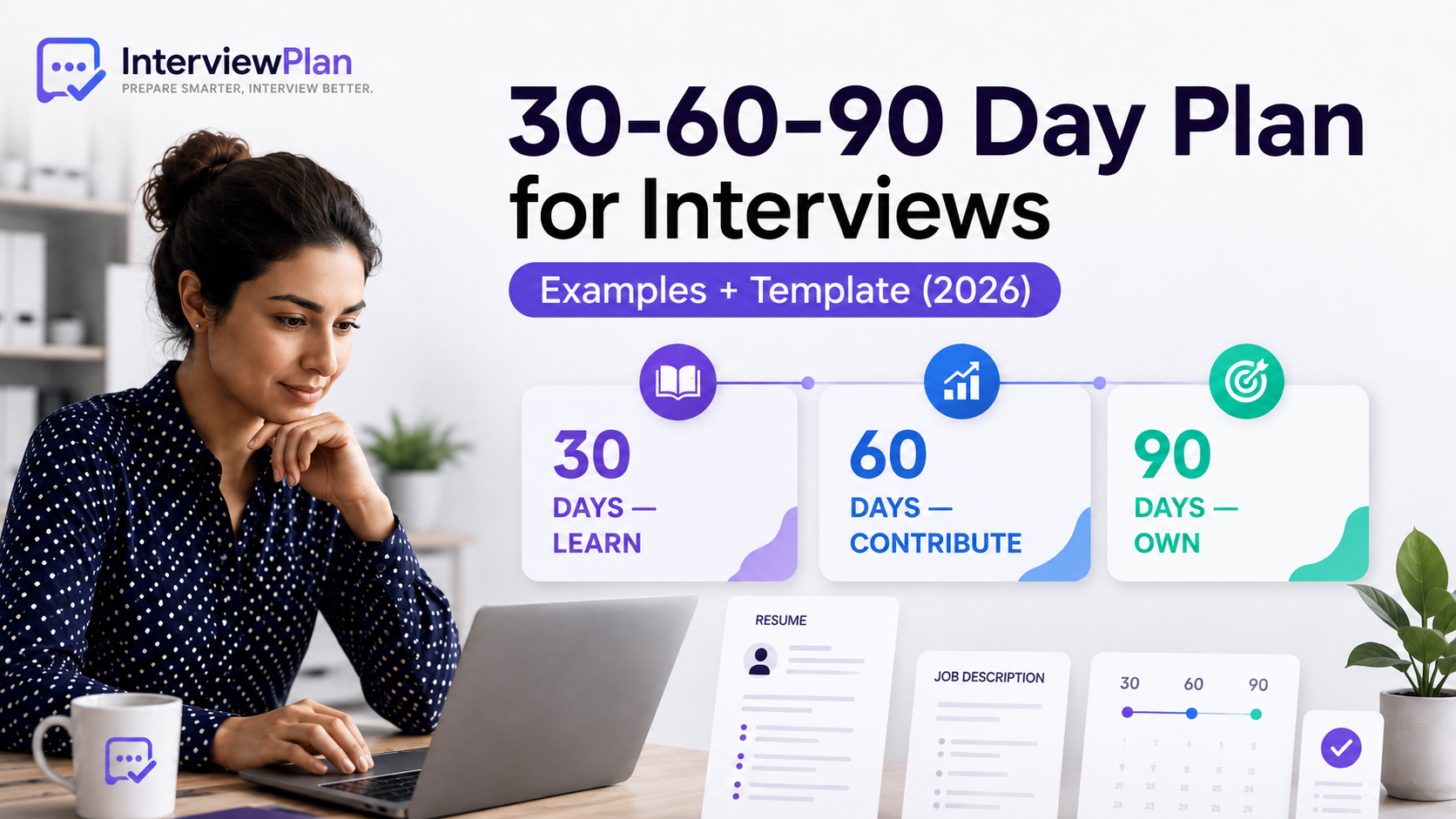
30-60-90 Day Plan for Interviews: Examples + Template
August 27, 2026 · Updated September 25, 2026
Preparing for an interview is no longer just about memorising answers to common questions. Employers increasingly want to understand how you think, how quickly you can learn, and how you would create value after joining the company.
That is why questions such as:
“What would you do in your first 30 days?”
“What would your first 90 days look like?”
“How would you approach your first three months?”
“What would you prioritise after joining us?”
are becoming increasingly important.
A strong 30-60-90 day interview plan gives you a structured way to answer them.
The simplest framework is:
First 30 days → Learn
Days 31–60 → Contribute
Days 61–90 → Own
You do not need to pretend you already know everything about the company.
Instead, your goal is to demonstrate that you can learn quickly, prioritise intelligently, communicate effectively, and turn knowledge into measurable results.
What Is a 30-60-90 Day Plan for an Interview?
A 30-60-90 day plan is a short roadmap explaining what you would focus on during your first three months in a new role.
It shows the interviewer how you would move from understanding the organisation to becoming a productive member of the team.
A good plan usually follows three stages:
TimelineMain FocusWhat You DemonstrateFirst 30 DaysLearnCuriosity and adaptabilityDays 31–60ContributeExecution and collaborationDays 61–90OwnAccountability and impact
The key is progression.
You are showing the interviewer that you understand that successful employees do not arrive on day one and immediately change everything.
They first understand the environment.
Then they contribute.
Then they take ownership.
The Best 30-60-90 Day Interview Framework
A simple way to remember your answer is:
Learn → Contribute → Own
This framework works across almost every profession.
Whether you are interviewing for a role in marketing, sales, software development, product management, business analysis, operations, or leadership, the structure remains the same.
What changes are the specific priorities.
First 30 Days: Learn Before You Change
During your first 30 days, your focus should primarily be on understanding the organization.
You might want to learn:
How the company makes money
Who the customers are
What the team's priorities are
How success is measured
What tools and systems are used
Who the important stakeholders are
What problems the team currently faces
How decisions are made
You should also understand the expectations of your manager.
A strong candidate demonstrates curiosity before certainty.
Example answer
“During my first 30 days, I would focus primarily on understanding the business, the team, and how success is measured in the role. I would meet the key stakeholders, learn the existing systems and processes, understand current priorities, and identify where my experience could provide the most value.”
This answer demonstrates confidence without sounding unrealistic.
Days 31–60: Start Contributing
During the second month, your answer should move from learning toward execution.
At this stage, you should begin taking ownership of your normal responsibilities.
Possible goals include:
Managing regular tasks independently
Supporting important projects
Improving an inefficient process
Identifying an early opportunity
Building stronger stakeholder relationships
Creating dashboards or reporting
Improving customer or team communication
You are essentially showing the interviewer:
“I expect to become useful quickly.”
Example answer
“By days 30 to 60, I would want to start turning what I learned into meaningful contributions. I would begin taking ownership of my responsibilities, identify one or two areas where I could create an early win, and regularly get feedback from my manager and stakeholders.”
Days 61–90: Take Ownership
By your third month, your answer should demonstrate independence.
You should be moving from contributor to owner.
Possible goals include:
Owning projects from start to finish
Delivering measurable results
Improving workflows
Managing stakeholders independently
Reporting against KPIs
Presenting recommendations
Building priorities for the next quarter
Example answer
“By day 90, my goal would be to operate independently in the role, take accountability for the core responsibilities, and have delivered at least one meaningful result. I would also want to understand the major priorities for the following quarter and have a clear plan for how I can continue creating value.”
Best Answer to “What Would You Do in Your First 90 Days?”
Here is a complete answer you can personalize for your next interview:
“In my first 30 days, my focus would be learning. I would want to understand the business, team, customers, systems, current priorities, and how success is measured in the position.
Between days 30 and 60, I would start turning that understanding into execution. I would take ownership of my regular responsibilities, look for an early opportunity where I could contribute, and continuously gather feedback from my manager and other stakeholders.
By day 90, my goal would be to operate independently, own measurable outcomes, and understand the priorities for the following quarter.
I would obviously refine the plan once I joined and understood the organization more deeply, but my general approach would be to learn first, contribute second, and then take ownership.”
This works because it sounds structured without sounding rehearsed.
How to Create Your Own 30-60-90 Day Plan
The strongest interview answers are personalized to the job description.
Here is how to build yours.
Step 1: Study the Job Description
Read the job description carefully.
Look for responsibilities that are repeatedly emphasized.
For example:
A marketing role might include:
Lead generation
Campaign management
Analytics
A business analyst role might include:
Requirements gathering
Process improvement
Stakeholder communication
A sales position might focus on:
Prospecting
Pipeline development
Closing revenue
These responsibilities should become the foundation of your plan.
Step 2: Identify What You Need to Learn
Ask yourself:
What information would I need before I could successfully perform these responsibilities?
Those items become your first 30-day goals.
For example:
If the company expects you to improve marketing performance, you first need to understand:
Existing campaigns
Target customers
Analytics
Previous results
Marketing tools
Sales feedback
Only then can you make intelligent recommendations.
Step 3: Identify an Early Win
For days 31–60, identify something you could realistically improve.
Avoid making unrealistic promises.
Instead of saying:
“I will increase sales by 40%.”
Say:
“I would review the sales funnel, identify where prospects are dropping off, and test improvements around the highest-priority opportunity.”
This demonstrates strategic thinking without inventing numbers.
Step 4: Explain What Ownership Looks Like
For your 90-day milestone, describe what you expect to manage independently.
For example:
“By 90 days, I would expect to own the weekly performance reporting process and provide recommendations based on the results.”
That sounds far stronger than simply saying:
“I hope to understand the role better.”
30-60-90 Day Plan Example for Sales
First 30 Days — Learn
Understand the product
Learn the ideal customer profile
Understand the sales process
Study the CRM
Listen to successful sales calls
Learn common customer objections
Days 31–60 — Contribute
Begin managing prospects independently
Build a consistent outreach routine
Improve objection handling
Develop pipeline
Test different messaging approaches
Days 61–90 — Own
Manage the sales cycle confidently
Maintain accurate forecasting
Build a healthy pipeline
Identify recurring objections
Share customer insights with leadership
30-60-90 Day Plan Example for Marketing
First 30 Days
Review current campaigns
Understand target customers
Learn the brand positioning
Review analytics
Meet sales and product teams
Understand marketing KPIs
Days 31–60
Take ownership of priority campaigns
Improve reporting
Test new creative ideas
Optimize existing campaigns
Build an experimentation backlog
Days 61–90
Manage campaign performance independently
Present marketing insights
Scale successful experiments
Improve reporting processes
Develop next-quarter priorities
30-60-90 Day Plan Example for Software Engineers
First 30 Days
Understand product architecture
Set up the development environment
Learn coding standards
Review documentation
Meet engineering stakeholders
Understand testing and deployment processes
Days 31–60
Resolve smaller production issues
Contribute to active projects
Participate in code reviews
Improve technical understanding
Start completing development tasks independently
Days 61–90
Own features independently
Participate in architectural discussions
Improve an engineering process
Contribute meaningfully to technical planning
30-60-90 Day Plan Example for Product Managers
First 30 Days
Understand product strategy
Review customer research
Study product metrics
Meet engineering and design
Understand the roadmap
Talk with sales and support teams
Days 31–60
Take ownership of a product initiative
Conduct customer discovery
Support prioritization
Identify product opportunities
Define success metrics
Days 61–90
Independently manage a product area
Present roadmap recommendations
Own product performance
Build priorities for the next quarter
30-60-90 Day Plan Example for Business Analysts
First 30 Days
Understand business objectives
Learn existing workflows
Understand systems
Meet business stakeholders
Meet technical stakeholders
Review existing documentation
Days 31–60
Take ownership of requirements gathering
Support stakeholder workshops
Improve documentation
Identify process gaps
Begin delivering analysis independently
Days 61–90
Own analysis for a key initiative
Produce recommendations
Improve communication between business and technology teams
Establish stronger reporting or requirements processes
Common 30-60-90 Day Interview Mistakes
Even experienced candidates sometimes answer this question poorly.
Here are the most common mistakes.
1. Being Too Generic
Saying:
“I will learn the company, work hard, and deliver results.”
does not differentiate you.
Your answer should connect directly to the job.
2. Promising Unrealistic Results
Avoid promising specific financial or performance outcomes when you have no access to the company's internal data.
Instead, explain how you would identify opportunities and improve performance.
3. Trying to Change Everything Immediately
Employers usually want someone who listens before making major decisions.
Your first month should demonstrate curiosity.
4. Focusing Only on Training
Learning is important.
But by 60 and 90 days, your answer should demonstrate increasing independence and ownership.
5. Giving an Overly Long Answer
Unless the interviewer specifically asks for a presentation, keep your verbal answer around 60–90 seconds.
Structure matters more than length.
Should You Bring a Written 30-60-90 Day Plan to an Interview?
For some roles, yes.
A written 30-60-90 day plan can be particularly effective when interviewing for:
Management roles
Sales positions
Product roles
Consulting positions
Marketing leadership
Operations
Senior-level positions
Keep the document simple.
One page is usually enough.
Use three sections:
First 30 Days
What will you learn?
Days 31–60
Where will you start contributing?
Days 61–90
What will you own?
Treat the document as a proposed strategy rather than a guarantee.
How InterviewPlan.AI Can Help You Prepare
Knowing the right framework is only one part of performing well in an interview.
The interviewer may phrase the question differently.
They may ask:
“What would your priorities be?”
“How quickly could you become productive?”
“What would success look like after 90 days?”
“What would you change first?”
“How would you measure your performance?”
“What would you focus on during your first week?”
InterviewPlan.AI helps candidates prepare using their CV and the job description as context, helping them structure more relevant answers for the role they are actually interviewing for.
Instead of memorising generic scripts, prepare your main ideas and practice communicating them naturally.
Think better. Answer confidently. Stay human.
Frequently Asked Questions
What is a 30-60-90 day plan for an interview?
A 30-60-90 day plan explains what you would learn, contribute, and take ownership of during your first three months in a new position.
How do I answer “What would you do in your first 90 days?”
Break your answer into three stages: spend the first 30 days learning, days 31–60 contributing independently, and days 61–90 taking ownership of meaningful responsibilities.
How long should my 30-60-90 day interview answer be?
For most interviews, approximately 60 to 90 seconds is enough unless the interviewer asks for a detailed presentation.
Should I bring a 30-60-90 day plan to an interview?
It can be particularly helpful for leadership, management, consulting, product, marketing, and sales roles where employers want to understand how you would approach the position.
What should I focus on during my first 30 days?
Focus on learning the business, team, customers, systems, priorities, performance metrics, and expectations before recommending major changes.
What should I accomplish by 90 days?
By 90 days, you should ideally be able to manage the core responsibilities of the position independently, have made at least one meaningful contribution, and understand the priorities for the next quarter.
Final Thought
The best 30-60-90 day interview answer is not the one that promises the biggest results.
It is the one that shows the interviewer you understand how to enter a new organisation intelligently.
Remember the framework:
30 Days: Learn
60 Days: Contribute
90 Days: Own
Build your answer around the job description, keep it realistic, and practice delivering it naturally.
That alone can turn a difficult interview question into one of your strongest answers.