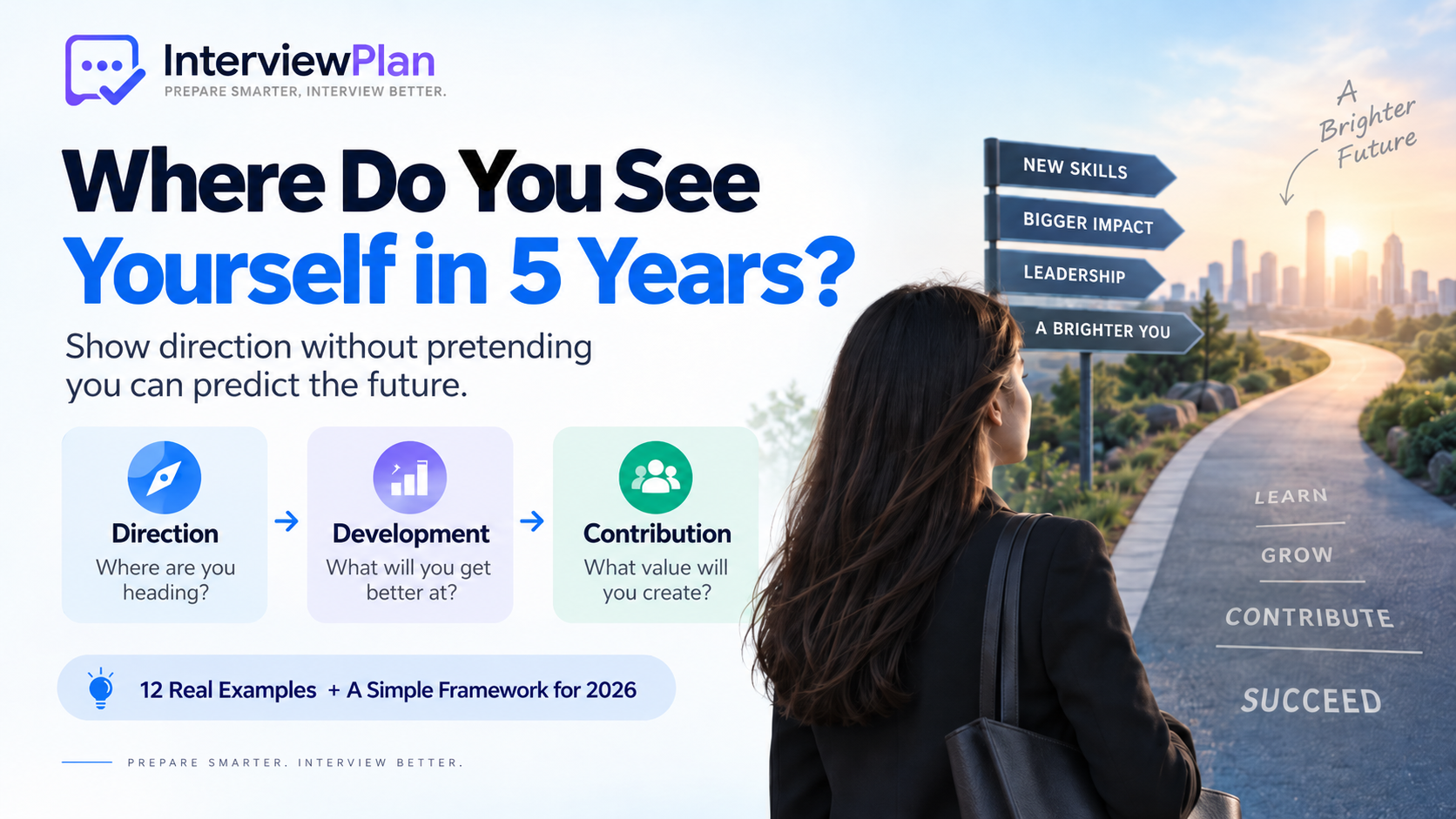
How to Answer “Where Do You See Yourself in 5 Years?” in 2026 + 12 Examples
September 23, 2026
“Where do you see yourself in five years?”
You don't need a perfect five-year prediction.
A strong answer should show that you have direction, realistic ambition, and a reason this particular job fits into your professional growth.
Instead of trying to name your exact future title, use this framework:
Direction → Development → Contribution
Explain where you want your career to move, which skills and responsibilities you want to develop, and the type of contribution you hope to be making.
For example:
“Over the next five years, I'd like to grow into someone who can independently lead larger product initiatives. In the near term, I want to strengthen my product strategy, customer research, and stakeholder-management skills while delivering strong results. Eventually, I'd also like to mentor less-experienced team members. That's one reason this role stood out to me—it offers exposure to the kind of projects I want to become stronger at leading.”
That's specific without pretending you can predict exactly what your career will look like in September 2031.
Why Do Interviewers Ask “Where Do You See Yourself in 5 Years?”
Interviewers usually aren't expecting you to predict the future perfectly.
They are trying to understand your career direction.
They may be evaluating:
whether you have thought about your professional development
whether your goals are realistic
whether this position makes sense as your next step
whether the employer can offer the kind of growth you want
whether you appear genuinely interested in the work
whether your expectations are compatible with the role
Indeed's current US guidance similarly notes that employers use the question to understand whether a candidate's goals and the opportunity reasonably align.
The real question behind the question is often:
“Does joining us make sense for where this person wants to go?”
Use the Direction → Development → Contribution Framework
You don't need an elaborate career map.
Build your answer in three parts.
1. Direction
Start with your general professional direction.
Examples:
becoming stronger in product strategy
moving toward leadership
becoming a technical specialist
owning larger customer accounts
gaining deeper industry expertise
managing increasingly complex projects
moving from execution toward strategy
Your direction should be broad enough to remain realistic.
You don't necessarily need to say:
“In five years, I will be Vice President of Marketing.”
You might instead say:
“Over the next several years, I'd like to take on more responsibility for marketing strategy and eventually lead larger cross-functional initiatives.”
That communicates ambition without making an arbitrary title prediction.
2. Development
What do you need to become better at to move in that direction?
Think about:
technical skills
leadership
communication
strategic thinking
customer management
project ownership
industry knowledge
decision-making
mentoring
cross-functional collaboration
For example:
“In the next few years, I want to strengthen my system-design skills and gain more experience making architectural decisions on production systems.”
Now the interviewer understands how you intend to grow.
3. Contribution
Finish with the type of value you hope to create.
Examples:
leading successful projects
improving customer outcomes
mentoring teammates
becoming a trusted specialist
improving processes
influencing strategy
owning a product area
helping grow a team
For example:
“Ultimately, I'd like to become someone the team can rely on for both complex technical decisions and mentoring newer engineers.”
Now your five-year answer is about more than what you want.
It also explains what you hope to contribute.
The Title-Light, Skill-Heavy Rule
One of the easiest ways to improve this answer is to stop obsessing over the exact title you'll have in five years.
Careers change.
Companies reorganise.
New technologies appear.
Industries evolve.
Your interests may change too.
Instead of building your entire answer around a title, talk about the things you want to become capable of doing.
Compare:
Too Title-Heavy
“In five years, I want to be a senior manager.”
What's missing?
What will you actually be better at?
Why management?
Why does this role help?
Now compare:
Skill-Heavy
“Over the next five years, I'd like to develop from individually managing campaigns into owning broader growth strategy and eventually mentoring other marketers. I want to strengthen my analytics, planning, and cross-functional leadership skills while continuing to deliver measurable acquisition results.”
The second answer shows an actual development path.
The job title can follow.
How Specific Should Your Five-Year Plan Be?
Aim for specific direction, flexible destination.
You want enough detail to show thoughtfulness.
But not so much detail that your answer sounds unrealistic.
A useful balance is:
Specific about skills.
Specific about responsibilities.
Specific about impact.
Flexible about exact title.
Flexible about exact timeline.
The Muse similarly recommends realistic career goals and notes that candidates do not necessarily need an exact future position figured out.
12 “Where Do You See Yourself in 5 Years?” Example Answers
Use these as structures rather than scripts.
Your answer should reflect your actual career direction.
1. Entry-Level Candidate
“Over the next five years, I want to build a strong foundation in data analysis and understand how analysis influences business decisions. In the short term, my priority is developing stronger SQL, visualisation, and stakeholder-communication skills. As I gain experience, I'd like to independently own larger analytical projects and become someone teams trust for clear, practical insights.”
2. Software Engineer
“In five years, I'd like to be an engineer who can independently design and own larger systems rather than focusing only on individual features. I want to deepen my backend architecture, cloud, and system-design skills and gradually take on more technical leadership. I'd also like to reach a point where I can mentor less-experienced engineers.”
3. Data Analyst
“I'd like to develop from primarily producing analysis into someone who can help shape business decisions through data. Over the next several years, I want to strengthen my statistical, visualization, and stakeholder-management skills while taking ownership of more complex projects. Eventually, I'd like to be a trusted analytics partner for business teams.”
4. Product Manager
“Over the next five years, I'd like to become stronger at owning products from discovery through execution and measurement. I want deeper experience with customer research, product strategy, and prioritization while managing increasingly complex product areas. Long term, I'd like to help guide broader product decisions and mentor newer product managers.”
5. Marketing Professional
“I'd like to move toward broader growth strategy over the next five years. Right now, most of my experience is in campaign execution, so my next priority is building stronger skills in forecasting, experimentation, analytics, and cross-channel planning. Eventually, I'd like to own a larger growth function and help develop the people on the team.”
6. Sales Professional
“In the next five years, I'd like to become someone who can manage larger, more complex customer relationships and consistently contribute to revenue growth. I want to improve my enterprise selling, negotiation, and account-strategy skills. Eventually, I'd also be interested in mentoring newer sales representatives.”
7. Career Changer
“Because I'm transitioning into business analysis, my main five-year goal is to build deep practical experience rather than chase a particular title. I'd like to become highly confident in requirements gathering, process analysis, SQL, and stakeholder communication and eventually independently lead larger analysis projects.”
This works because career changers don't need to pretend they already know every step of the new career path.
8. Recent Graduate Who Isn't Sure Yet
It's okay not to know your exact destination.
You can still show direction.
“I don't have one exact job title mapped out five years from now. My immediate priority is building strong experience in UX design, working with real users, and learning from experienced designers. Over time, I'd like to understand whether my strengths are better suited to research, product design, or a more specialized area. What matters most to me right now is developing a strong foundation.”
Uncertainty is different from having no thought at all.
9. Senior Candidate
“Over the next five years, I'd like to continue moving toward broader strategic ownership. I've spent most of my recent career leading individual initiatives, and I'd like to increasingly influence portfolio-level decisions, develop other leaders, and improve how teams make strategic tradeoffs. I'm less focused on a particular title than on increasing the scale of the problems I'm capable of solving.”
10. Individual Contributor Who Doesn't Want Management
You do not have to pretend you want to manage people.
“My goal isn't necessarily to move into people management. Over the next five years, I'd like to become a deeper technical specialist and take ownership of increasingly complex engineering problems. I'd like to become someone other engineers consult for architecture and performance decisions while still remaining hands-on.”
A specialist path can be just as ambitious as a management path.
11. Customer Success Professional
“I'd like to become stronger at managing strategic customer relationships and helping customers achieve measurable outcomes from the product. Over the next several years, I want to deepen my account strategy and product knowledge, manage larger accounts, and eventually become someone who can mentor other customer success managers.”
12. Project Manager
“In five years, I'd like to be leading larger cross-functional programs with more strategic responsibility. My next step is strengthening my stakeholder management, risk planning, and resource-management skills while continuing to deliver projects reliably. Over time, I'd like to take ownership of programs that span multiple teams rather than individual projects.”
What If You Don't Know Where You'll Be in Five Years?
You are not alone.
You don't need to invent certainty.
Avoid:
“I honestly have no idea.”
Instead, explain what you do know.
For example:
“I don't have an exact future title mapped out, but I know I want to become substantially stronger in product analytics and take ownership of larger decisions. Over the next few years, I want exposure to customer research, experimentation, and product strategy so I can understand which direction I eventually want to specialise in.”
The answer acknowledges uncertainty while still showing intention.
What If You Want to Start Your Own Business?
This one needs judgment.
If your real plan is:
“I'm leaving in 18 months to launch a direct competitor.”
That may understandably concern the employer.
You do not need to disclose speculative plans that aren't relevant to the job.
Instead, answer the question around the professional capabilities you genuinely want to build:
“Over the next five years, I'd like to become much stronger in product development, customer research, and commercial decision-making. I want to take on increasing ownership and understand more of how successful products are built and grown.”
Stay truthful.
But answer what is relevant to the employment decision.
What If You Want the Interviewer's Job?
Don't say:
“I want to be sitting in your chair.”
Even as a joke.
It can sound unnecessarily competitive.
Instead:
“Longer term, I'd like to move into leadership. My immediate focus, though, is becoming excellent at the responsibilities of this role and gradually taking on broader ownership as I gain experience.”
Ambition is good.
Impatience is less helpful.
What If You Plan to Go Back to School?
If further education is a serious and relevant part of your plan, think about how it affects the role.
You could say:
“Over the next five years, I want to deepen my experience in financial analysis, and I may eventually pursue additional education related to finance or strategy. My immediate focus is gaining meaningful professional experience and increasing the complexity of the work I can own.”
Avoid presenting the job as something you're merely using to fill time.
Mistakes to Avoid
1. “I Don't Know”
Not knowing your exact future is fine.
Showing no thought about your development is weaker.
2. Choosing an Unrealistic Title
Moving from entry-level employee to CEO in five years is technically possible.
It is not usually a useful interview answer.
Choose ambitious but credible development.
3. Making Everything About Promotion
Career growth isn't only:
Junior → Senior → Manager → Director
Growth may also mean:
expertise
responsibility
impact
complexity
influence
mentoring
customer ownership
4. Saying You Plan to Leave Immediately
Avoid:
“This role would be good for a year or two, and then I'd move somewhere bigger.”
Even if career mobility is normal, the answer makes the employer wonder why they should invest in hiring you.
Focus on the development opportunity in front of you.
5. Giving the Answer You Think They Want
Don't tell an interviewer:
“I want to stay at this company forever.”
if you don't mean it.
Your answer should be believable.
6. Focusing Only on What You'll Receive
Weak:
“I want more money, promotions, training, and better opportunities.”
Stronger:
“I want to develop stronger technical leadership skills so I can take responsibility for increasingly complex projects and eventually help mentor other engineers.”
The second answer combines growth with contribution.
Connect Your Five-Year Answer to the Job Description
This is where a generic answer becomes a strong interview answer.
Read the job description.
Identify three things:
1. What can you learn here?
For example:
enterprise sales
system design
leadership
product strategy
customer research
2. What responsibility can you grow into?
For example:
larger projects
strategic accounts
team leadership
product ownership
cross-functional programs
3. What value could you eventually contribute?
For example:
mentoring
technical leadership
revenue ownership
process improvement
strategic decision-making
Then connect them.
For example:
“One reason this position appeals to me is the opportunity to work directly with enterprise customers. That's an area I want to become significantly stronger in over the next several years, and eventually I'd like to own larger strategic accounts and help newer account managers develop.”
Now the answer could not be pasted into every interview unchanged.
Your 5-Year Answer Builder
Complete these five sentences before your interview:
The professional direction I want to move toward is:
A skill I want to become significantly stronger at is:
A responsibility I want to grow into is:
The contribution I hope to make at that level is:
This position helps me move in that direction because:
Now turn those answers into approximately 45–75 seconds of natural conversation.
How Can AI Help You Prepare?
AI can help you identify the relationship between your existing experience, the job description, and realistic next-step career goals.
A useful preparation workflow is:
Add your resume.
Add the target job description.
Identify the skills the position could help you develop.
Identify realistic responsibilities you could grow into.
Draft your Direction → Development → Contribution answer.
Practice likely follow-up questions.
Remove statements that aren't genuinely yours.
Practice aloud until the answer sounds conversational.
InterviewPlan.AI can help you prepare using your resume and target role so your interview practice reflects your experience rather than generic scripts.
The objective isn't to have AI predict your career.
It's to help you communicate your career direction more clearly.
Frequently Asked Questions
What is the best answer to “Where do you see yourself in five years?”
A strong answer explains the professional direction you want to pursue, the skills or responsibilities you want to develop, and the contribution you hope to make. Connect those goals naturally to the position you're interviewing for.
Do I need to name a specific job title?
No. A specific title can work if your path is clear, but it is often better to focus on skills, responsibilities, expertise, and impact rather than pretending you know your exact future title.
What if I don't know what I want to do in five years?
You can say that you haven't decided on an exact destination while still describing the skills and experiences you want to develop. Interviewers are generally looking for thoughtful direction, not perfect prediction.
Should I say I want to become a manager?
Only if management genuinely interests you. If you'd rather remain an individual contributor and deepen your expertise, explain that path instead.
Can I say I want the interviewer's position?
It's usually better to express interest in leadership or broader responsibility without saying you specifically want the interviewer's job.
Should my answer mention the company?
It can help to connect your growth goals with opportunities available in the role or organisation, but avoid making promises about staying with one employer forever.
How long should my answer be?
For most candidates, approximately 45–75 seconds is enough. The goal is to communicate direction clearly without presenting a five-minute career plan.
Final Takeaway
“Where do you see yourself in five years?” isn't really a test of your ability to predict 2031.
It's a test of whether your next step has direction.
Remember:
Direction → Development → Contribution
Explain where you want to go.
Explain what you want to become better at.
Explain the kind of value you hope to create.
Then connect that growth to the opportunity you're interviewing for.
You don't need a perfect five-year plan.
You need a next step that makes sense.
Ready to Practice?
Use InterviewPlan.AI to prepare with your resume and target job description, practice realistic interview questions, and refine your answers before the real interview.
Prepare Smarter. Interview Better.