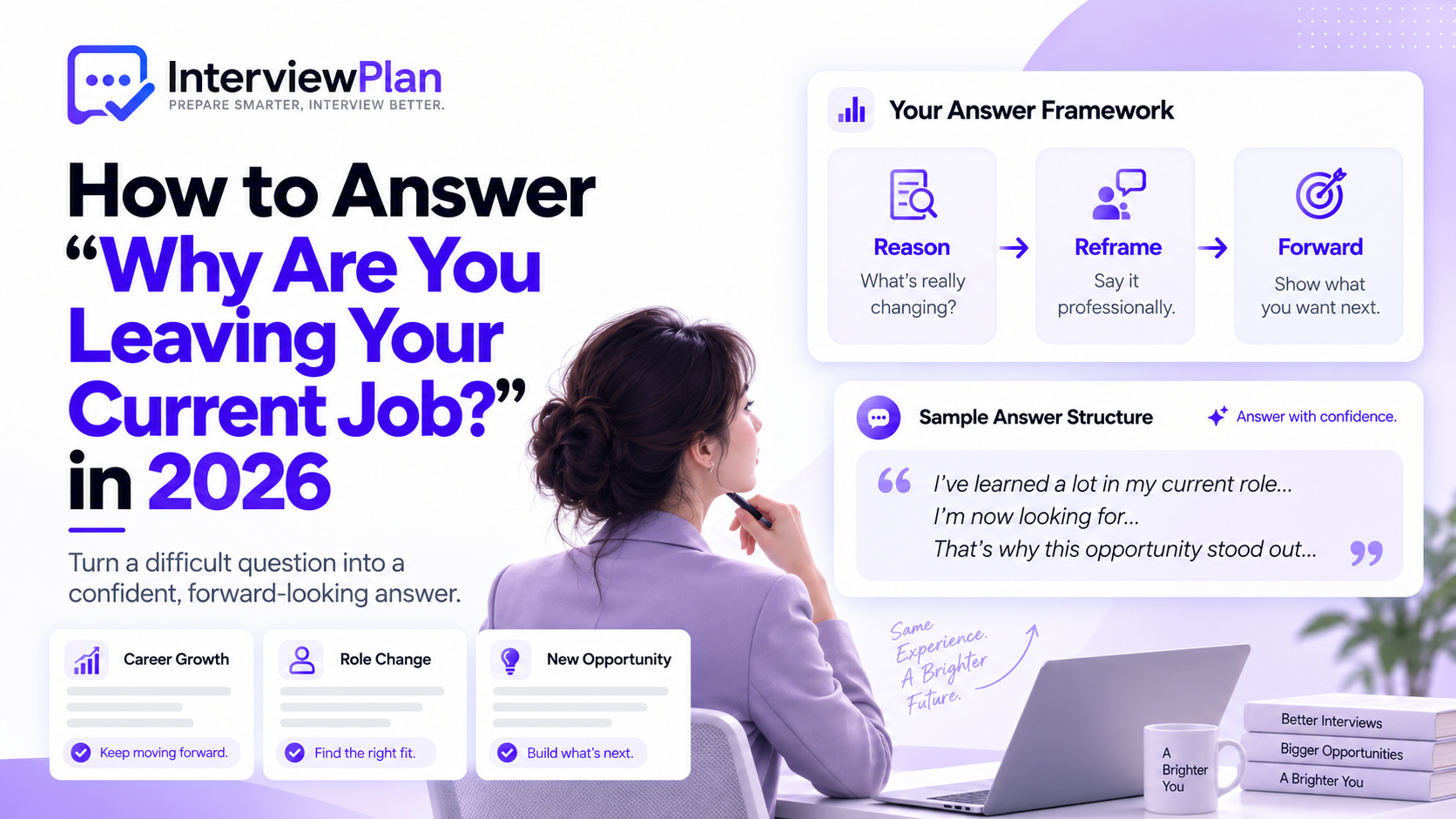
How to Answer “Why Are You Leaving Your Current Job?” in 2026 + 12 Examples
September 15, 2026 · Updated September 15, 2026
“Why are you leaving your current job?”
It sounds like a simple question.
But your answer can reveal a lot about how you approach work, career decisions, difficult situations, and professional relationships.
A strong answer should be honest, brief, professional, and forward-looking.
A useful framework is:
Reason → Reframe → Forward
Explain the real reason for the transition without unnecessary detail, frame it professionally rather than emotionally, and then connect your decision to what you are looking for in the new role.
For example:
“I've learned a lot in my current position, but opportunities to take on broader product ownership are limited. I'm ready for a role where I can be more involved in strategy and customer outcomes, which is one of the reasons this position caught my attention.”
You answered the question.
You did not criticize anyone.
And you moved the conversation toward the opportunity in front of you.
Why Do Interviewers Ask Why You're Leaving Your Job?
Interviewers aren't necessarily looking for a dramatic explanation.
They are trying to understand the logic behind your career move.
Your answer can help them assess:
what motivates you
what you're looking for next
how professionally you discuss previous employers
whether the new position actually solves what caused you to leave
whether your expectations align with the opportunity
how you handle difficult career situations
Current US career guidance similarly recommends giving an honest explanation while keeping it professional and connecting the transition to future goals.
The interviewer may be thinking:
“If we hire this person, are they likely to be satisfied here?”
That's why your answer should explain both the departure and the destination.
The Best Framework: Reason → Reframe → Forward
You don't need a complicated story.
Build your answer in three parts.
1. Reason
State the real reason you're considering leaving.
Examples:
limited growth
restructuring
relocation
career change
seeking greater responsibility
compensation
role changed
company direction changed
layoff
wanting a different working environment
Don't create a fake reason because it sounds more impressive.
You need an answer you can defend naturally if the interviewer asks a follow-up question.
2. Reframe
Now express the reason professionally.
For example:
Instead of:
“My boss has no idea what he's doing.”
Try:
“I'm looking for an environment with clearer ownership and stronger alignment around priorities.”
Instead of:
“I'm completely burned out.”
Try:
“I've realized I'm looking for a role with a more sustainable working structure and clearer long-term priorities.”
Reframing does not mean lying.
It means communicating the situation without turning the interview into a complaint session.
3. Forward
Finish by explaining what you want next.
For example:-
“I'm looking for a role where I can own larger projects and work more closely with customers, which is what attracted me to this position.”
This part matters because it turns your departure into a career decision rather than simply an escape.
Think:
What am I moving toward?
Not only:
What am I trying to get away from?
Use the 20/80 Transition Rule
A useful preparation rule is to spend less time explaining the past and more time explaining the future.
Think approximately:
20% — why you're leaving
80% — what you're looking for next and why this role fits
For example, compare these two answers.
Too Past-Focused
“My manager changed last year, and since then communication has been terrible. Projects constantly change direction, no one knows the priorities, and I don't feel appreciated. That's why I've decided to leave.”
The interviewer now has several new concerns.
Was the manager really the problem?
How does the candidate respond to change?
Will they speak about our company like this later?
Now compare:
Forward-Focused
“There have been some changes in how my current team is structured, and I've realized I'm ready for an environment where I can take clearer ownership of projects. This position stood out because it appears to give the role end-to-end responsibility, which is exactly what I'm looking for next.”
Same general situation.
Very different impression.
12 Sample Answers for “Why Are You Leaving Your Current Job?”
Use these as frameworks, not scripts.
Your answer should reflect what actually happened.
1. You're Looking for Career Growth
“I've had a positive experience in my current position and learned a lot, but the team is relatively small and there isn't much room to take on broader responsibilities. I'm looking for a role where I can continue developing and eventually own larger projects, which is one reason this opportunity interested me.”
Why it works:
You aren't criticizing your employer.
You're explaining a reasonable next step.
2. You Want More Responsibility
“My current role has given me a strong foundation, but I'm ready to take greater ownership of projects and decisions. I've gradually taken on more responsibility, and I realized my next step should be a position where that ownership is formally part of the role. That's what attracted me to this opportunity.”
3. You're Changing Careers
“Over the last few years, I've realized that the part of my work I enjoy most is data analysis and solving operational problems. I've been developing my SQL and analytics skills outside my core responsibilities, and I'm now looking to move into a business analyst position where those skills are central to the job.”
This makes the career change sound intentional rather than impulsive.
4. Your Company Is Restructuring
“The company is going through a restructuring process and my team's responsibilities are changing significantly. It's given me an opportunity to think carefully about what I want next, and I'm particularly interested in roles where I can continue working directly on customer-facing product initiatives.”
If your job is actually being eliminated, say so clearly.
Don't make a restructuring sound voluntary if it isn't.
5. You Were Laid Off
A layoff is different from being fired for individual performance.
Indeed's current US guidance similarly recommends being straightforward about a layoff and explaining the business circumstances without presenting it as something it was not.
For example:
“My position was eliminated as part of a broader restructuring that affected several members of the team. I enjoyed the role and left on good terms. Since then, I've been focusing on opportunities where I can use my project-management experience in a larger product organization, which is what interested me about this position.”
Keep it factual.
You do not need to apologize for being laid off.
6. You Were Fired
This situation requires more care.
Don't claim you were laid off if you were actually terminated for performance or another individual reason.
Be honest, concise, take appropriate responsibility, and explain what changed afterward.
For example:
“I was let go because I wasn't meeting the performance expectations of the position. Looking back, there were areas where I should have asked for feedback earlier and been more proactive about clarifying priorities. I've taken that experience seriously and changed how I communicate progress and request feedback. I'm now looking for a role that fits my strengths more closely, particularly around client strategy and communication.”
The interviewer may ask follow-up questions.
That's okay.
Your objective is not to pretend the experience never happened.
It's to demonstrate maturity and learning.
7. You Don't Like Your Manager
Do not spend your interview attacking your current manager.
Even if your frustration is legitimate.
Instead, identify what you need professionally.
For example:
“I've realized that I do my best work in an environment with clear priorities and regular collaboration between managers and team members. I'm looking for an organization where that communication style is more established, and from what I've learned during this process, this team seems to work that way.”
Keep the focus on working style rather than personality conflict.
8. You're Leaving Because of Compensation
Compensation is a legitimate reason to change jobs.
But saying:
“I just want more money.”
may make the interviewer wonder whether you will immediately leave again when another company offers more.
A stronger version is:
“Compensation is one factor, but the bigger reason I'm exploring opportunities is that my responsibilities have grown substantially while the scope and progression of the role haven't changed. I'm looking for a position where the responsibilities, growth path, and compensation are more closely aligned.”
You don't need to pretend money doesn't matter.
Just explain the full career decision.
9. You're Burned Out
Avoid turning the interview into a detailed description of everything wrong with your current workplace.
You might say:
“The workload and structure of my current position have changed considerably, and it helped me realize that I'm looking for an environment with clearer priorities and a more sustainable long-term way of working. I'm still ambitious about the work I take on—I just want to make sure I'm in an environment where I can consistently perform at my best.”
The goal is to communicate what you learned about the environment you need.
10. You're Relocating
This answer can be straightforward.
“I'm relocating to Chicago for personal reasons, and my current employer doesn't have a position available there. I've therefore started exploring opportunities in the area, and this role stood out because it closely matches my experience in financial analysis.”
No complicated explanation is required.
11. You Want Remote or Hybrid Work
Remote work may be an important factor, but avoid making it sound like the only reason you care about the position.
For example:
“My current organization is moving to a fully in-office model, and I'm looking for a hybrid environment that better fits how I've been working successfully over the last several years. That said, I applied to this role because the responsibilities are also a strong match for my experience in customer success.”
Work arrangement + professional fit.
Not work arrangement alone.
12. Your Role Changed After You Joined
Sometimes the job you accepted is no longer the job you have.
You can explain that professionally:
“The position has evolved significantly since I joined, and most of my responsibilities are now focused on operational reporting rather than the product-analysis work I was originally hired to do. I've realized I want to return to a role where customer and product analysis are a larger part of the job, which is why this opportunity stood out.”
This explains the mismatch without accusing the employer of intentionally misleading you.
What If You're Still Employed?
If you haven't left yet, keep your answer in the present tense.
For example:
“I've learned a lot in my current role and I'm not looking to leave simply for the sake of changing jobs. I'm exploring opportunities because I'm ready for greater strategic responsibility, and this position appears to offer that next step.”
This can be especially powerful because it shows selectivity.
You're not trying to escape immediately.
You're considering a deliberate move.
What If You're Unemployed?
The interviewer may phrase the question differently:
“Why did you leave your last job?”
Your structure remains similar:
Reason → Reframe → Forward
For example:
“My previous position ended when the company consolidated the marketing function after an acquisition. Since then, I've been using the time to strengthen my analytics skills and focus on roles that combine growth strategy with data, which is why I was interested in this position.”
Keep the departure factual.
Then move forward.
Should You Tell the Whole Truth?
You should be truthful.
But truthful does not mean providing every emotional or interpersonal detail.
Suppose the actual situation is:
Your manager repeatedly changed priorities, you were frustrated, the team lost several people, and you eventually decided to leave.
You do not need to provide a ten-minute chronology.
A truthful professional summary could be:
“The team went through several organisational changes, and over time I realised I was looking for a role with clearer ownership and a more stable scope.”
That's accurate.
It's also appropriate for an interview.
Should You Say You Hate Your Current Job?
No.
Even if you do.
The interviewer's question isn't:
“Tell me everything wrong with your employer.”
It is:
“Why are you considering a transition?”
Answer that question instead.
What Should You Never Say?
1. “My Boss Is Terrible”
Even if true, it makes the conversation about conflict.
Talk about the environment you want rather than attacking an individual.
2. “I Hate Everyone There”
Don't.
3. “I Just Want More Money”
Compensation can be part of the answer.
Give the interviewer a broader professional reason as well.
4. “I'm Bored”
Try:
“I'm looking for more challenging responsibilities and greater ownership.”
Same underlying issue.
More professional communication.
5. “There's Too Much Work”
Clarify the actual problem.
Is it workload?
Lack of prioritization?
Unclear scope?
Staffing?
A mismatch in expectations?
Then explain what you are seeking in your next environment.
6. “I Don't Know. I Just Need Something Different.”
The interviewer may interpret that as:
This candidate doesn't know what they want.
Know what you're moving toward.
The New-Employer Test
Before using your answer, ask:
Could the same problem happen in the company I'm interviewing with?
Suppose you say:
“I'm leaving because I hate working with clients.”
But you're interviewing for another client-facing role.
That's a fit problem.
Or:
“I don't like fast-changing environments.”
while interviewing at an early-stage startup.
Again, potential mismatch.
Your answer should make sense in the context of the job you're trying to get.
That is why reading the job description carefully matters.
How Long Should the Answer Be?
For a straightforward situation, 30–60 seconds is usually enough.
If your situation is more complicated—such as being fired, changing careers, or explaining a significant employment gap—the interviewer may ask follow-up questions.
Don't preemptively give a five-minute explanation.
Start concise.
Then answer whatever they ask next.
How to Tailor Your Answer to the New Job
Before the interview, identify:
What are you leaving?
Write the reason in one sentence.
What are you moving toward?
Identify two or three things you want in your next position.
Examples:
broader ownership
stronger technical challenges
leadership opportunities
customer exposure
career progression
a new industry
more strategic work
different working arrangement
Does the new role actually provide those things?
Find evidence in the job description or interview process.
Then connect them.
For example:
“I've spent the last three years primarily executing paid campaigns, and I'm ready to move into a role with more responsibility for overall acquisition strategy. I noticed this position includes channel planning, budget ownership, and performance strategy, which is exactly the progression I'm looking for.”
Now your decision has logic.
How Can AI Help You Prepare This Answer?
AI can be useful because this question often needs to be personalized carefully.
A productive preparation workflow is:
Add your resume.
Add the target job description.
Write the real reason you want to leave.
Remove unnecessary emotional detail.
Identify what you're looking for next.
Connect that goal to the new position.
Practice likely follow-up questions.
Say the answer aloud and rewrite anything that doesn't sound natural.
InterviewPlan.AI can help you prepare around your actual resume, experience, and target role instead of practicing only generic interview scripts.
The goal isn't to invent a more impressive reason for leaving.
It's to communicate your real reason more clearly.
5-Minute Preparation Worksheet
Before your interview, complete these sentences.
My real reason for leaving is:
The professional version of that reason is:
What I learned from the experience is:
What I want in my next role is:
This new position appears to offer that because:
Then combine those points into a 30–60 second response.
Frequently Asked Questions
What is the best answer to “Why are you leaving your current job?”
The best answer is truthful, concise, professional, and future-focused. Explain your reason briefly, avoid criticizing your employer, and connect your transition to something specific you are seeking in the new position.
Is career growth a good reason for leaving a job?
Yes. Wanting greater responsibility, skill development, leadership opportunities, or career progression can be a strong reason when you explain specifically what growth you are seeking.
Can I say I'm leaving because of my manager?
You can explain that the working environment or management style is not the right fit, but avoid personal attacks. Focus on the communication, structure, or working style you perform best within.
Should I tell an interviewer that I was laid off?
Yes. Be accurate about what happened. If your position was eliminated during a restructuring or reduction in force, explain it briefly and then shift toward what you're doing next.
Should I say I was fired?
Do not describe a firing as a layoff. If you were terminated, answer honestly, keep the explanation concise, take appropriate responsibility, explain what you learned, and show what has changed.
Can salary be my reason for leaving?
Yes, but it is usually stronger to explain compensation as one part of a broader career decision involving responsibilities, progression, market value, or the scope of your next role.
What if I genuinely dislike my current job?
Identify the underlying professional reason. Instead of explaining everything you dislike, describe what you want to be different in your next position.
How long should my answer be?
For most straightforward situations, around 30–60 seconds is enough. More complex departures may require additional explanation if the interviewer asks follow-up questions.
Final Takeaway
You don't need the perfect reason for leaving.
You need a clear and credible explanation.
Remember:
Reason → Reframe → Forward
Tell the truth.
Keep the past concise.
Avoid turning former colleagues or managers into villains.
Then explain what you're moving toward and why the new position makes sense.
The interviewer shouldn't finish your answer thinking:
“What's wrong with their current employer?”
They should be thinking:
“I understand why this next step makes sense.”
Ready to Practice Before Your Interview?
Use InterviewPlan.AI to prepare with your resume and target job description, practice realistic interview questions, and refine your answers before the real conversation.
Prepare Smarter. Interview Better.