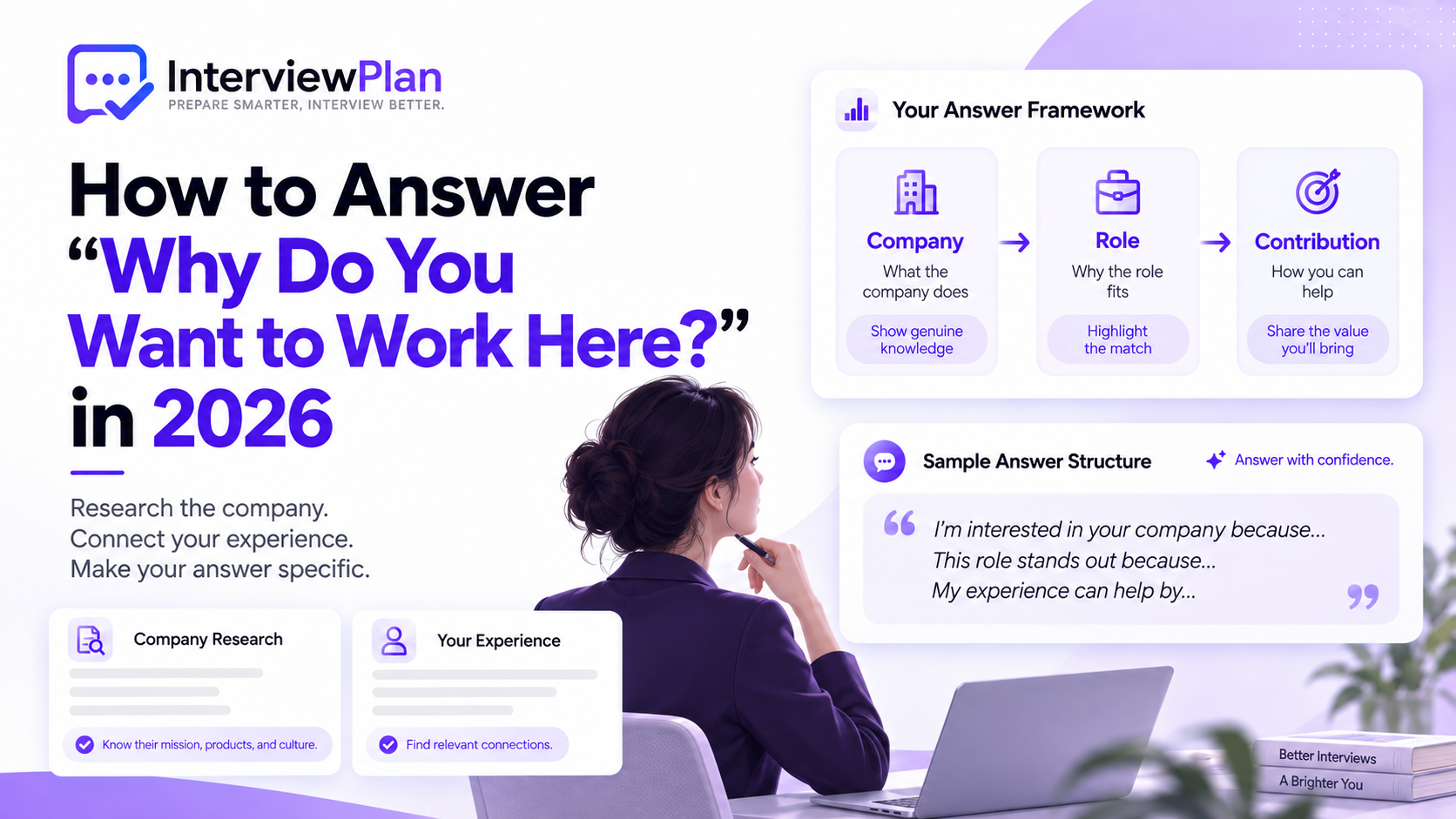
How to Answer “Why Do You Want to Work Here?” in 2026
September 10, 2026 · Updated September 10, 2026
“Why do you want to work here?”
A strong answer should explain why this specific company and role make sense for you—and what you can contribute if hired.
Avoid generic praise such as “Your company has a great reputation” or “I'm looking for an exciting opportunity.”
Instead, use this simple framework:
Company → Role → Contribution
Mention something specific you have learned about the employer, connect it to the work you genuinely want to do, and explain how your experience could create value.
The goal isn't to flatter the interviewer.
It's to prove your application was deliberate.
Why Do Interviewers Ask “Why Do You Want to Work Here?”
Interviewers are usually trying to understand more than whether you like the company.
Your answer helps them evaluate whether:
you researched the organization
you understand the position
your motivation is genuine
the opportunity fits your career direction
your experience aligns with what they need
you can explain why this employer stands out from your other options
US career guidance from Indeed, the University of Pennsylvania, and MIT Sloan similarly emphasizes employer research and connecting the company, position, and candidate's qualifications.
That means the weakest answer is usually one that could be delivered at 20 different companies without changing anything except the name.
What Is the Best Answer to “Why Do You Want to Work Here?”
Use:
Company → Role → Contribution
A strong answer might sound like this:
“One reason I was interested in your company is the way you've been expanding the product for smaller business customers. I noticed this role combines customer research with product marketing, which closely matches the work I've enjoyed most in my current position. I've spent the last three years turning customer insights into campaigns and positioning recommendations, so I'd be excited to bring that experience to a team working on that kind of growth.”
Notice the structure.
Company
The candidate mentions something specific about the employer.
Role
They explain which part of the actual job interests them.
Contribution
They connect relevant experience to how they could help.
That is much stronger than:
“I've always wanted to work for a great company like yours because I think it would be an amazing opportunity to grow.”
The second answer sounds positive.
But it tells the interviewer almost nothing.
“Why Do You Want to Work Here?” vs. “Why Do You Want This Job?”
These questions overlap, but they are not identical.
“Why do you want to work here?” places more emphasis on the employer.
Think about:
company
product
customers
mission
industry
team
business direction
“Why do you want this job?” places more emphasis on the position itself.
Think about:
responsibilities
skills
projects
career progression
type of work
level of ownership
A good answer may touch both.
But listen carefully to what the interviewer actually asked.
How Do You Research a Company Before Answering?
You don't need to spend three hours researching every employer.
You do need enough information to explain why your interest is specific.
Use this five-part research method.
1. Read the Company's Website
Start with:
homepage
About page
product/service pages
careers page
newsroom
leadership pages
Don't copy the mission statement into your answer.
Look for something that genuinely connects with your interests or experience.
2. Read the Job Description Again
Most candidates research the company and forget to research the role.
Identify the three most important responsibilities.
Ask yourself:
Which part of this job would I actually enjoy doing?
Your answer should probably mention one of those responsibilities.
3. Look at Recent Company Developments
Depending on the organization, useful information may include:
product launches
expansion into a new market
acquisitions
customer initiatives
new leadership
technology changes
partnerships
company announcements
Only mention something you have verified.
Don't tell an interviewer:
“I love the new product you launched.”
if you haven't actually understood what the product does.
4. Understand the Company's Customers
Ask:
Who does this company help?
A candidate interviewing for a software company, for example, should usually understand whether the product serves:
consumers
startups
enterprises
healthcare organizations
retailers
developers
financial institutions
Understanding the customer can make your answer substantially more specific.
5. Research the Team When Possible
If your interview invitation tells you who you are meeting, review their professional background.
You might discover:
how the department is structured
what type of work the team focuses on
how the position relates to other roles
what experience the hiring manager values
Don't turn the interview into a demonstration of how thoroughly you searched the interviewer online.
Use the information to understand the context—not to make the conversation uncomfortable.
The 10-Minute “Why This Company?” Research Sheet
Before the interview, fill in these six lines:
Company:
What does the company actually do?
Customers:
Who does it serve?
Recent development:
What has the company recently built, changed, announced, or prioritized?
Role:
Which responsibility interests me most?
Connection:
Which part of my experience connects with that responsibility?
Contribution:
What could I realistically help the team do?
Once you have those six answers, your interview response becomes much easier to build.
Use the Logo-Swap Test
Here is one of the fastest ways to check whether your answer is too generic.
Write your answer.
Then remove the employer's name and replace it with one of its competitors.
Does the answer still work perfectly?
For example:
“I want to work at Microsoft because it's an innovative global technology company with a great culture and opportunities to learn.”
Now replace Microsoft with Google.
The sentence still works.
Replace it with Amazon.
It still works.
That means you haven't really explained why Microsoft.
Now compare:
“What especially interests me is how this team is building tools for enterprise customers adopting AI across their existing workflows. I've spent the last two years implementing automation projects for business teams, so the opportunity to work directly on that kind of adoption challenge is particularly relevant to my experience.”
The second answer is harder to swap between employers because it connects the actual opportunity with the candidate's experience.
That's the standard you want.
How Long Should Your Answer Be?
For most interviews, approximately 30–60 seconds is enough to make your point clearly.
You do not need to recite everything you discovered about the organization.
Choose:
one company detail + one role connection + one contribution
Then stop.
The interviewer can ask follow-up questions if they want more detail.
10 “Why Do You Want to Work Here?” Sample Answers
Use these examples as structures rather than scripts.
Your final answer should reflect the actual company and your real experience.
1. Entry-Level Candidate
“What attracted me to this role is that it combines analytics with direct exposure to business decisions. During college and my internship, the projects I enjoyed most involved using data to understand a problem and then presenting recommendations. I also noticed that your team works across several product areas, so this seems like a strong place to contribute while building broader analytical experience.”
2. Software Engineer
“I'm particularly interested in the scale of the engineering problems this team is working on. From what I've read about the product, reliability and performance become increasingly important as customer usage grows. In my current role, I've spent a lot of time improving backend performance and monitoring, so the technical problems in this position line up closely with the work I enjoy and where I can contribute.”
3. Product Manager
“One thing that stood out to me is your focus on making the product easier for smaller teams to adopt. I've spent the last few years working on onboarding and activation for B2B software products, and I especially enjoy identifying where customers get stuck and working across product, design, and engineering to improve that experience. That's why this role feels particularly relevant to my background.”
4. Data Analyst
“I was interested in the position because the analytics team appears to work directly with operational and product stakeholders rather than functioning only as a reporting team. In my current role, the work I enjoy most is turning analysis into recommendations that teams can actually use. I'd like to continue developing in an environment where analytics has that level of business involvement.”
5. Sales Professional
“Your focus on expanding within the mid-market segment caught my attention because that's where I've spent most of my recent sales experience. I've worked with customers who need a consultative approach rather than a purely transactional sales process, and I think that experience would translate well to the customer profile you're targeting.”
6. Marketing Candidate
“What interested me most was the combination of demand generation and positioning in the role. I've managed acquisition campaigns in my current position, but I've also increasingly been involved in customer research and messaging. This role would let me bring those areas together, which is exactly the direction I want to develop.”
7. Career Changer
“I'm moving from operations into business analysis, and this role stood out because the work involves process improvement and stakeholder communication—two areas I've already spent several years working in. I've been developing my analytics skills specifically so I can combine that operational experience with more structured data analysis, so the position feels like a logical next step rather than a completely unrelated change.”
8. Recent Graduate With Limited Experience
“I became interested in the company while researching teams working in healthcare technology. The part that especially appeals to me is the opportunity to work on tools that affect how healthcare teams manage everyday workflows. My academic projects focused heavily on user research and interface design, so I'm excited by the opportunity to apply those skills to real operational problems.”
9. Manager or Senior Candidate
“I'm interested in the stage the organization appears to be entering. The team is growing, but the role still seems to involve building processes rather than simply inheriting established ones. In my current position, I've led a team through a similar growth stage and built clearer planning and reporting processes as we expanded. I enjoy that kind of environment, so the challenge here is especially appealing.”
10. Remote Role
“The remote structure is attractive, but it isn't the main reason I applied. What really interested me is the combination of customer strategy and cross-functional work in the position. I've spent the last four years collaborating across distributed teams, so I'm comfortable working remotely, but I'm applying because the actual responsibilities line up closely with where I can contribute.”
Notice the difference in the last example.
Compare:
“I want the job because it's remote.”
Remote work may genuinely matter to you.
But the interviewer still needs to know why the job itself interests you.
What Should You Not Say?
“Because I Need a Job”
It may be completely true.
It just doesn't help the employer understand why this particular opportunity makes sense.
“I Heard You Pay Really Well”
Compensation matters.
But salary alone doesn't explain your professional interest in the work.
“Your Company Is Very Prestigious”
Prestige is not a contribution.
Explain what specifically interests you.
“I Love Your Culture”
How do you know?
If you mention culture, point to something you have actually observed or learned.
“This Would Look Great on My Resume”
The interviewer is evaluating what happens while you work there—not how quickly the company becomes a line on your resume.
“I've Always Dreamed of Working Here”
Only say something like this if it is genuinely true and you can explain why.
Manufactured enthusiasm is easy to overdo.
What If You Don't Know Much About the Company?
That's a preparation problem you can solve before the interview.
If the organization has a limited public presence, focus on what you can verify:
the position description
product or service
customers
industry
people you've spoken with during the hiring process
You can say:
“I'm still learning about the organization, but two things have stood out during the process so far…”
Then mention real observations.
It is better to be specific about limited information than confident about things you invented.
What If You Don't Agree With Every Company Value?
You do not need to pretend a company's mission statement changed your life.
Your answer can focus on:
the work
customers
technical challenges
product
business model
responsibilities
career fit
Authentic professional interest is enough.
What If You Are Interviewing With Several Companies?
That's normal.
You don't need to tell every interviewer they are your only option.
Your job is simply to explain:
Why does this particular opportunity make sense?
Several companies can be attractive for different legitimate reasons.
Should You Mention Career Growth?
Yes, but don't make the answer entirely about what the company will give you.
Weak:
“I want to work here because you'll give me opportunities to grow.”
Better:
“The role would let me build deeper product strategy experience, but it also connects closely with my current customer-research background, so I think I could contribute while growing into the broader responsibilities.”
Growth + contribution is stronger than growth alone.
How to Personalize Your Answer From the Job Description
Take the job description and highlight:
Skills required
What do you already do well?
Responsibilities
Which ones genuinely interest you?
Business outcomes
What is this person actually being hired to accomplish?
Experience requirements
Which of your experiences provide the strongest evidence?
Then build:
“I noticed the role emphasizes [responsibility]. That's an area I've been working on through [experience], and I particularly enjoy [specific aspect]. Combined with [verified company detail], that's what made this opportunity stand out to me.”
Now you have a reusable framework without giving a reusable generic answer.
How Can AI Help You Prepare This Answer?
AI can make the preparation process faster, but it shouldn't invent your motivation.
A useful workflow is:
Add your resume.
Add the job description.
Identify the responsibilities most relevant to your experience.
Research the employer separately.
Select one genuine reason the company interests you.
Draft your Company → Role → Contribution response.
Practice likely follow-up questions.
Rewrite anything that does not sound like your normal speaking style.
InterviewPlan.AI can help you prepare around your resume, experience, and target role so your practice reflects the interview you're actually preparing for rather than generic questions alone.
Your final answer should still sound like you.
5-Minute Final Checklist
Before the interview, ask:
Did I name something specific about the company?
Did I explain why the actual role interests me?
Did I connect my experience with the opportunity?
Did I explain something I could contribute?
Would my answer survive the Logo-Swap Test?
Actually, the last question should be:
Would my answer FAIL the Logo-Swap Test?
That's what you want.
If you can replace the employer with five competitors and nothing changes, personalise the answer again.
Frequently Asked Questions
What is the best answer to “Why do you want to work here?”
The best answer connects a specific, verified reason you are interested in the company with a responsibility you genuinely want to perform and experience you can use to contribute. A simple structure is Company → Role → Contribution.
How long should my answer be?
For most interviews, around 30–60 seconds is enough. Focus on one meaningful company detail, one reason the role fits you, and one contribution rather than listing everything you learned during your research.
Should I mention the company's mission?
Yes, if the mission genuinely matters to you and you can explain the connection. Repeating a mission statement without explaining why it matters to you will usually sound generic.
Can I say I want to work there because of the culture?
You can, but explain what evidence shaped that impression. Mentioning people you have met, working practices you learned about, or something observable is more convincing than simply saying the company has “a great culture.”
What if I'm applying mainly because I need a job?
You can still identify why this specific opportunity makes sense compared with other jobs. Focus on the responsibilities, industry, company, customer, or skills that make the position relevant to you.
What's the difference between “Why do you want this job?” and “Why do you want to work here?”
“Why do you want this job?” emphasizes the position and responsibilities. “Why do you want to work here?” places greater emphasis on the employer. Strong answers often connect both the company and the role.
Should I mention salary?
Salary can matter when deciding whether to accept a job, but it generally should not be the centerpiece of this answer. Use this question to explain the professional reasons the company and position interest you.
Final Takeaway
You don't need to convince an interviewer that their company has been your lifelong dream.
You need to show that you chose to apply for a reason.
Remember:
Company → Role → Contribution
Research something specific.
Connect it to work you genuinely want to do.
Explain where your experience fits.
Then run the Logo-Swap Test.
If your answer sounds equally convincing after replacing the company's name with a competitor, it isn't specific enough yet.
Want to practice before the real interview?
Use InterviewPlan.AI to prepare around your resume and job description, practice realistic interview questions, and refine your answers until they sound clear, relevant, and natural.
Prepare Smarter. Interview Better