Interviewing for remote US and UK roles from India
Team InterviewPlan · November 5, 2026 · Updated November 5, 2026
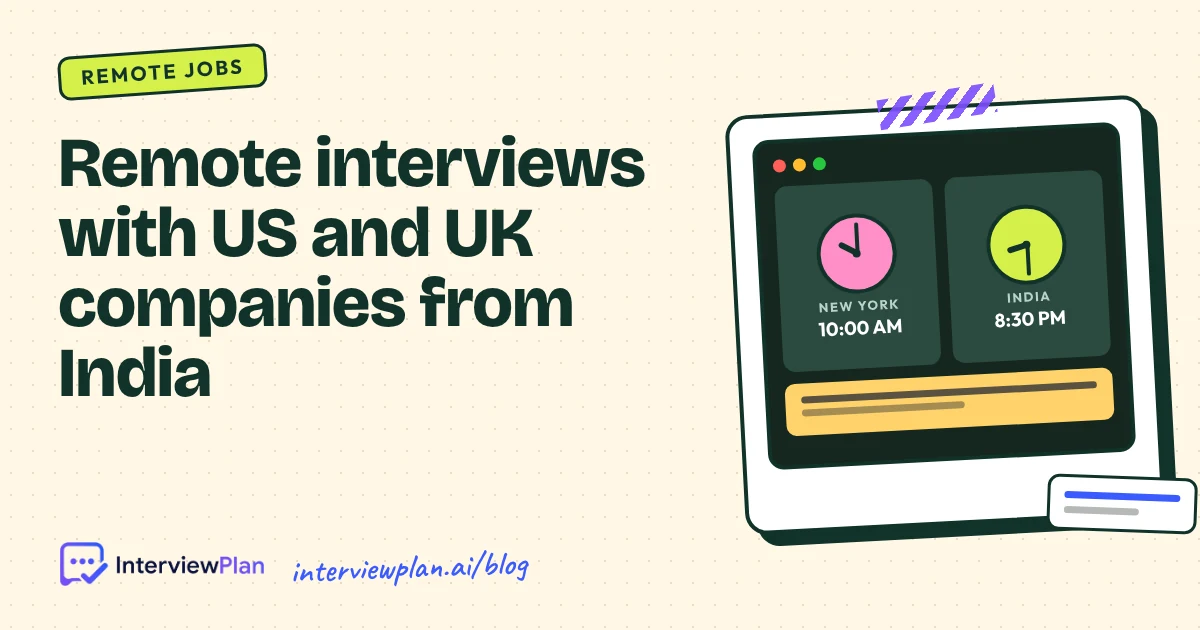
For remote US and UK interviews from India, confirm the time zone in writing, prove you can work with limited overlap, and show strong written communication. Prepare answers about async work, self-management and handling time differences, know the employment model on offer, and discuss pay in the currency and structure the company actually uses.
A remote role with a US or UK company can be a big step for an Indian IT professional: a global team, new problems and often a different pay structure. But the interview is not the same as one for an Infosys or TCS project, or even for a Bengaluru product startup. The questions shift from "can you do the work?" to "can you do the work without anyone watching, nine time zones away?"
This guide covers what changes in remote interviews with overseas companies, the questions you should expect, and how to answer them. For the basics of camera and audio, see our video interview tips. Here we focus on the remote and cross-border part.
What do US and UK companies test in a remote interview?
Your technical skills still matter most. But for a remote hire in another country, hiring managers are also quietly scoring a few extra things, because a bad remote hire is expensive and hard to fix.
Written communication: most remote teams run on Slack messages, tickets and design docs. A clear email before the interview counts.
Async working: can you make progress when your manager is asleep, and leave a clean handover when you log off?
Ownership: do you raise blockers early, or wait to be chased?
Overlap and reliability: will you actually be online for the hours you promise, with stable power and internet?
Cultural ease: can you disagree politely, push back on unclear requirements and join small talk without discomfort?
Every answer you give is a chance to prove one of these. A story about fixing a bug becomes stronger if you mention how you documented it for the US team before they came online.
How do you handle time zones when scheduling the interview?
Time zone mix-ups are the most avoidable way to miss a remote interview. They happen more than you would think, especially around daylight saving changes, when the gap between India and the US or UK shifts by an hour. India does not change its clocks, but the UK and US do, on different dates.
Company location | Their time | India time (IST) |
|---|---|---|
UK, winter (GMT) | 10:00 am | 3:30 pm |
UK, summer (BST) | 10:00 am | 2:30 pm |
US East, winter (EST) | 10:00 am | 8:30 pm |
US East, summer (EDT) | 10:00 am | 7:30 pm |
US West, winter (PST) | 10:00 am | 11:30 pm |
US West, summer (PDT) | 10:00 am | 10:30 pm |
When a recruiter suggests a time, reply with both time zones written out: "Confirming Tuesday 10:00 am EST, which is 8:30 pm IST for me."
Accept the calendar invite and check that your calendar shows it at the right local time.
For US West Coast calls, it is fine to suggest their early morning, which is your late evening, rather than taking a 1:00 am slot.
Set two reminders, one the day before and one an hour before, because evening slots clash with family time and festivals.
Know your platform in advance. Many US teams use Zoom or Google Meet, and some UK enterprises use Microsoft Teams.
Which remote work questions should you prepare for?
Beyond the role-specific technical questions, expect a set of remote work questions. They often come from the hiring manager, not HR, so treat them seriously.
"How do you handle working across time zones?"
They want to hear a system, not just "I am flexible." Here is how Ananya, a data analyst applying to a London fintech, answered:
In my current role, I work with a client team in Chicago, so we have about two hours of overlap in my evening. I keep that window for discussions and decisions, and do focused work in my morning. Before I log off, I post a short update in the team channel: what I finished, what is blocked and what I need from them. That way, when they start their day, they are not waiting on me. With a UK team the overlap would be much larger, so I could be available most of your morning and early afternoon.
"Tell me about a time you worked with little supervision."
Pick a story where you made a sensible decision alone and kept people informed. Mention how you decided what was safe to decide yourself and what needed sign-off. That judgement is what remote managers worry about most.
"What does your home work setup look like?"
Be specific and calm. Mention your main internet connection, your backup (mobile hotspot or a second broadband line), power backup if you have an inverter, and a quiet room. Do not overstate it, but show you have thought about reliability.
"Why do you want to work remotely?"
Avoid answers that are only about you, like skipping traffic. Focus on the work: you do your best focused work with fewer interruptions, you enjoy written communication, and you have already proven it in a distributed team. You can adapt the structure from our tell me about yourself guide to make your opening pitch mention remote experience early.
How should you talk about salary and employment type?
Pay conversations for overseas remote roles are more complicated than a usual CTC discussion, because the structure can vary a lot. Before you name a number, find out how you would be engaged.
Employer of Record (EOR): a third-party company employs you in India on the overseas company's behalf. You usually get Indian payroll, PF and statutory benefits.
Indian subsidiary: the company has its own Indian entity, so it is close to a normal Indian job with a global team.
Independent contractor: you invoice the company, often in USD or GBP. Pay may look higher, but you handle your own tax, insurance and leave.
Hybrid arrangements: some companies pay a fixed monthly retainer with project bonuses. Read the contract closely.
Ask the recruiter directly: "Will this role be through an EOR, an Indian entity, or as a contractor? And is the salary band in INR, USD or GBP?" Once you know, you can give a range that makes sense. Our salary expectations guide explains how to phrase a range without boxing yourself in.
Based on the scope of this role and my five years in data engineering, I am looking for a range of X to Y in your local currency if I am engaged as a contractor. If it is through an employer of record in India, I would want to look at the full package, including benefits and leave, before confirming a number.
How do you communicate clearly with a global panel?
You do not need to change your accent. You do need to be easy to follow on a laptop speaker by someone who may be hearing Indian English for the first time.
Slow down by about 10 to 20 percent from your normal pace, especially when stating numbers and names.
Start answers with the headline, then the details. Many US and UK interviewers expect the conclusion first.
Avoid local abbreviations and phrases like "do the needful", "revert back" or "prepone", which can confuse.
Explain Indian context briefly when it matters. "I served a 90-day notice period, which is standard in India" helps.
If you did not catch a question, ask: "Sorry, could you repeat the last part?" It is far better than guessing.
What should you do after a remote interview?
Follow up in writing within one working day of their time zone, not yours. A short, specific thank you email that references something from the conversation also shows the written communication skills they are hiring for.
Keep a simple tracker of every overseas application: company, time zone, employment model, stage and next step. Remote searches often involve many parallel processes, and roles can move slowly when panels are spread across continents.
How can you find and prepare for more remote roles?
Volume matters in remote job searches because competition is global. InterviewPlan AI's Auto-Apply for remote jobs can tailor and queue applications for you, and every single one waits for your approval before it is sent. Pair that with a few practice rounds so time zone questions and pay questions feel natural.
On interview day, the Interview Copilot desktop app gives you a live, speaker-labelled transcript, which helps a lot with unfamiliar accents, and drafts answers from your own resume. Only you can see it, and you should always follow each employer's interview rules. Try InterviewPlan AI free with 5 live minutes and 100 AI credits, no card needed.
Frequently asked questions
How do I prepare for a remote job interview with a US company from India?
Confirm the interview time in both time zones in writing, test your setup on their platform, and prepare answers about async work, overlap hours and working with little supervision. Research how the company hires in India, such as an employer of record or contractor model, before you discuss pay.
What questions are asked in a remote job interview?
Expect questions on how you handle time zones, how you communicate progress when your team is offline, a time you worked with little supervision, your home work setup and backup internet, and why you want to work remotely. Technical and role-specific questions still make up most of the interview.
Should I quote salary in INR or USD for a remote role?
Ask the recruiter how the role is engaged and which currency the band uses before you give a number. Contractor roles are often paid in USD or GBP, while employer of record and Indian entity roles are usually paid in INR with statutory benefits. Compare total packages, not just headline numbers.
How many hours of overlap do US companies expect from India?
It varies by team. Many ask for a few hours of overlap, often in your evening for the US East Coast. Ask the hiring manager directly what overlap the team expects and be honest about what you can sustain long term, not just during the first month.
Do I need to change my accent for US or UK interviews?
No. Focus on clarity instead: speak a little slower, lead with the main point, avoid local phrases that may confuse, and ask for repetition if you miss something. Clear structure matters far more to interviewers than accent.