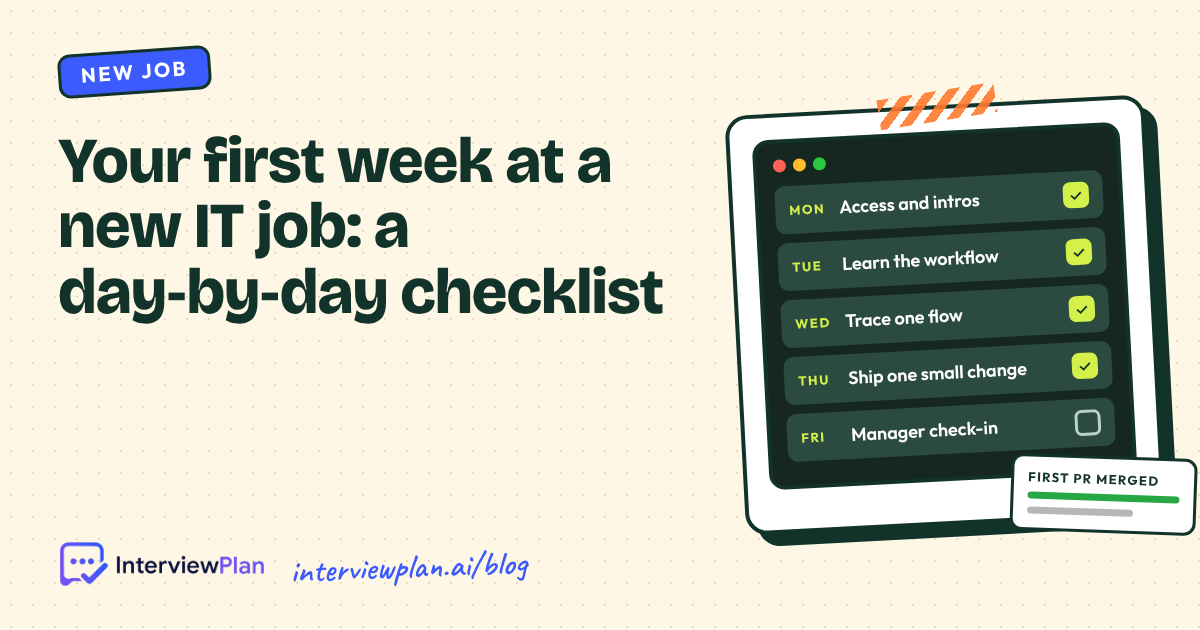
In your first week at a new IT job, focus on four things: get every access and tool working, meet your manager and key teammates, understand how work flows from ticket to release, and ship one small, safe change. End the week with a short check-in with your manager to confirm expectations for the next month.
The first week in a new IT job is strange. You have just survived months of interviews, a long notice period and probably a farewell lunch. Now you are back at the bottom of a learning curve, with a laptop that is still installing updates and a team chat full of acronyms you do not know.
The good news is that nobody expects you to be productive yet. They expect you to be curious, organised and easy to work with. This checklist breaks the week into five days, so you always know what to focus on. For the longer view, pair it with our first 90 days plan.
What should you do before day one?
A little preparation the weekend before removes most of the first-day stress.
Re-read the job description and your interview notes. Write down the three things the manager said mattered most.
Check your joining email for documents: ID proof, education certificates, relieving letter from your last company, bank details for payroll and PF transfer details.
Confirm the time, location or video link, and who to contact if something goes wrong.
Brush up on the core stack named in the job description. Thirty minutes of revision on the framework or cloud platform goes a long way.
Prepare a 30-second introduction for stand-ups and team calls.
Day 1 (Monday): How do you get set up and make a good first impression?
Day one is mostly HR formalities, laptop setup and introductions. Your goal is simple: leave the day with working access and a list of names.
Complete HR and payroll forms properly. Mistakes here delay your first salary.
Request every access you will need: email, VPN, code repository, ticketing tool, cloud console, databases, CI/CD and team channels. Keep a list of what is pending.
Ask your manager or buddy for the onboarding document, architecture diagram and team wiki.
Introduce yourself in the team channel with a short, friendly message.
Write down names, roles and one thing about each person you meet.
Hi everyone, I am Karthik, and I have joined as a backend developer on the payments team. I spent the last four years at Accenture working mostly on Java and Spring Boot services for a banking client. Looking forward to working with you all, and please bear with my questions this week.
Day 2 (Tuesday): How do you understand the team and how work flows?
Once your access is mostly working, shift to understanding how the team actually works. This is where most new joiners save weeks of confusion later.
Attend the stand-up and simply listen. Note which services, tools and names keep coming up.
Ask your buddy to walk you through one recent ticket from start to finish: how it was created, reviewed, tested and released.
Learn the branching strategy, code review rules and how deployments happen.
Find out the team's working hours, especially if you work with US, UK or Australian clients.
Ask where people go for help: a support channel, an on-call rota or a specific senior engineer.
If you are moving from a large service company to a product company, this day matters even more. Processes are often lighter, and much of the knowledge lives in people's heads rather than documents.
If you joined remotely, make this day deliberately social. Ask your buddy for a 20-minute video call instead of only chatting, keep your camera on in team meetings, and message two or three teammates to ask what they are working on. Remote new joiners who stay silent in the first week often stay invisible for months.
Start a simple personal notes file today. Use headings like people, tools, services, jargon and open questions. By Friday it will be the most useful document you own, and it makes your check-in with your manager far easier to prepare.
Day 3 (Wednesday): How should you approach a new codebase or system?
Do not try to read the entire codebase. Pick one feature or flow and trace it from end to end.
Get the project running locally. Write down every step that was not in the README, then offer to update it. This is often your first useful contribution.
Choose one user action, like "place an order" or "generate a report", and follow it through the code, database and logs.
Draw your own rough diagram of the main services and how they connect.
Read the last few merged pull requests to understand the coding style and what reviewers comment on.
Keep a running list of questions, and ask them in batches rather than one at a time.
For non-developer roles the same idea applies. A business analyst traces one requirement from request to release. A Power BI developer follows one report from source tables to the published dashboard.
Day 4 (Thursday): How do you pick and deliver your first task?
By Thursday, ask your manager or buddy for a small, low-risk ticket: a minor bug, a test, a documentation fix or a small UI change. The goal is not impact. It is to go through the full process once.
Clarify the acceptance criteria before you write any code.
Keep your change small so it is easy to review.
Write a clear pull request description: what changed, why and how you tested it.
Respond to review comments quickly and politely, even if you disagree.
Celebrate quietly when it merges, then note what slowed you down.
Getting stuck is normal. The rule many experienced engineers follow is to try on your own for a reasonable time, then ask with context: what you tried, what you expected and what happened. That kind of question is easy for a busy teammate to answer.
Day 5 (Friday): What should you cover in your end-of-week check-in?
Ask your manager for a 20-minute check-in on Friday if one is not already scheduled. Come prepared. This one conversation sets the tone for your first month.
Topic | Question to ask | Why it matters |
|---|---|---|
Expectations | What would a great first 30 days look like for me? | Gives you a clear target |
Priorities | Which area should I go deep on first? | Stops you spreading too thin |
Feedback | How do you prefer to give and get feedback? | Avoids surprises later |
Communication | When should I message you versus raise it in stand-up? | Respects their time |
People | Who else should I meet in the next two weeks? | Builds your network early |
Also share a short summary of your week: access sorted, flows understood, first ticket done and what you plan for next week. Managers remember new joiners who report progress without being asked.
What mistakes should you avoid in your first week?
Comparing everything to your old company. "At my last job we did it better" lands badly in week one, even if it is true. Save suggestions for later.
Staying silent to look capable. Not asking questions leads to slow progress and wrong assumptions.
Overpromising. Saying "I can finish that by tomorrow" before you understand the system creates pressure you do not need.
Skipping the social part. Join the team lunch or the virtual coffee. Relationships make the next 90 days easier.
Working late every day. It sets an expectation you will not want to keep.
What if the new stack or project feels overwhelming?
Feeling out of your depth in week one is very common, especially if the stack is different from what you used before, or if you have been moved to a project on day three. It does not mean you were the wrong hire. It means you are learning fast.
Break the gap into small, specific topics and learn them one at a time. Ask your buddy which two or three things are worth learning first. If you want structured help while you get up to speed, InterviewPlan AI's Job Support combines AI with expert help in your first 90 days, covering stand-ups, tickets and code reviews, with role-specific support such as Java, AWS and business analyst work.
Job Support costs $5 per hour, each hour includes 200 AI credits, and hours never expire. It is designed to help you understand and do your own work better, within your employer's policies. You can try InterviewPlan AI free with 5 live minutes and 100 AI credits, no card needed.
Frequently asked questions
What should I do in my first week at a new job?
Get all your access and tools working, meet your manager and key teammates, learn how work flows from ticket to release, trace one feature through the system and deliver one small, safe change. Finish the week with a short check-in with your manager about expectations for the first month.
How do I make a good impression in my first week?
Be curious and organised rather than trying to look like an expert. Ask clear questions in batches, take notes, introduce yourself warmly, respond quickly to messages and share a short summary of your progress at the end of the week. Avoid comparing everything to your previous company.
Is it normal to feel lost in the first week of a new IT job?
Yes, it is very normal. New codebases, tools and team habits take time to learn, and most managers expect little output in week one. Focus on understanding one flow at a time, ask your buddy what to learn first and track small wins so you can see your progress.
What documents do I need on my first day in an Indian IT company?
Most companies ask for ID proof, education certificates, your relieving and experience letters from the last employer, recent payslips, bank details for salary and your PF or UAN details for transfer. Check your joining email for the exact list, as it varies by company.
When should I ask my manager for feedback in a new job?
Ask for a short check-in at the end of your first week. Use it to confirm what a great first 30 days looks like, which area to focus on and how your manager prefers to give feedback. After that, agree on a regular rhythm, such as a weekly or fortnightly one-to-one.