Resignation in December if your bonus is already paid, your notice period is 60 days or more, and your new employer wants you by February or March. Wait until January if a bonus, a vesting date or a gratuity milestone lands within the next few weeks. The right date comes from your own documents, not the calendar.
Diwali is done, the offer is in hand, and now the question is when to submit your resignation. Should you resign in December 2026 or wait until January 2027? Your resignation date can affect your bonus, ESOP vesting, gratuity eligibility, notice period and final joining date. Here's how to work it out before putting in your papers.
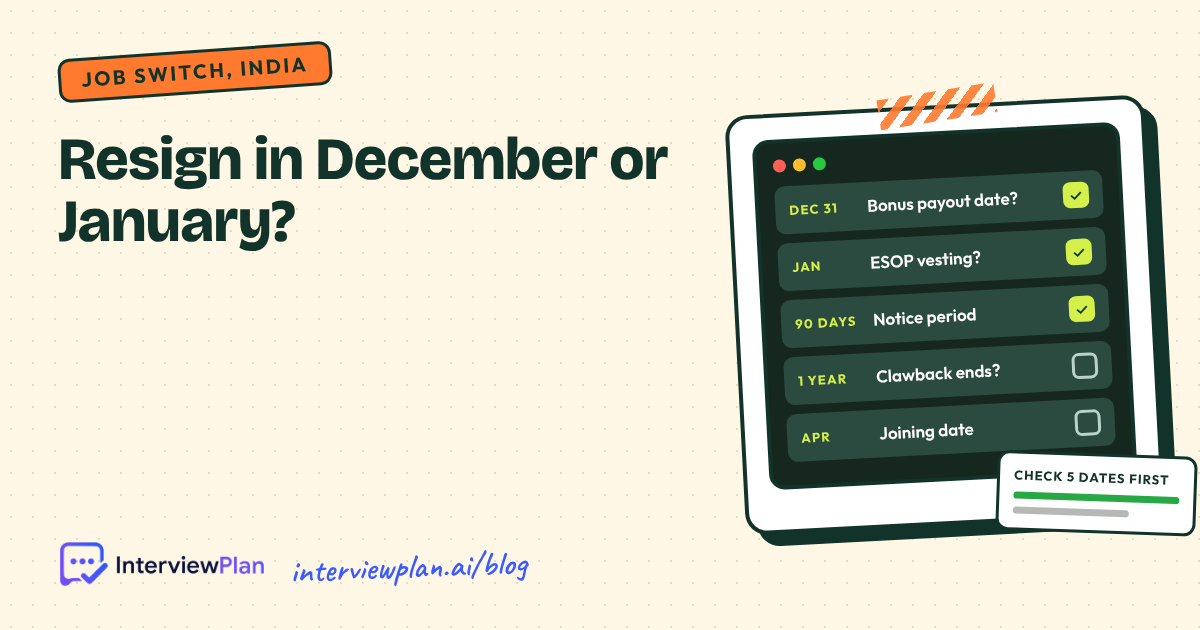
Step 1: Find the five dates that matter
Before you choose a date, find these in your offer letter, appointment letter, HR policy portal or payslips:
Date | Where to find it | Why it matters |
|---|---|---|
Bonus or variable pay payout | Appointment letter, variable pay policy, past payslips | Many policies pay only if you are still employed, and not serving notice, on the payout date |
Joining bonus or relocation clawback end | Your current offer letter | If you leave before the clawback period ends, often 12 months, you may have to repay it |
Stock or ESOP vesting date | Grant letter, equity portal | Unvested units usually lapse on your last working day |
Gratuity eligibility | HR policy, joining date | See the labour codes note below |
Your notice period | Appointment letter | Decides your last working day, and so your joining date |
Read the exact wording. "Paid to employees on the rolls on the payout date" is very different from "paid pro rata for the period worked".
Step 2: Calculate Your Resignation Date Based on Your Notice Period
Your new employer has given you a joining date, or a window. Count back by your notice period:
Notice period | Resign on | Last working day, about |
|---|---|---|
30 days | 1 December 2026 | 31 December 2026 |
60 days | 1 December 2026 | 30 January 2027 |
90 days | 1 December 2026 | 1 March 2027 |
90 days | 4 January 2027 | 4 April 2027 |
With 90 days' notice, resigning on 4 January instead of 1 December pushes your joining date into April. Check whether your new employer will hold the offer that long. Most offers state a latest joining date. If yours doesn't, ask.
Step 3: Check the money you might leave behind
Bonus and variable pay
If a payout is due in December or January, resigning before it can cost you all of it. Ask HR one plain question: "Is the payout made to employees serving notice?" Get the answer in writing.
Joining bonus clawback
If you are within your clawback period, work out the repayment amount. Some new employers will compensate it as a joining bonus if you ask, with proof.
Leave balance
Earned leave is often encashed in your full and final settlement. Some companies let you set it off against the notice period instead. Check which applies to you.
Gratuity, and what the labour codes changed
India's four labour codes came into force on 21 November 2025 (The Week, AZB & Partners). Fixed-term employees now qualify for gratuity after one year of service. For permanent employees, the usual requirement is still five years of continuous service. If you're close to either line, confirm the exact rule your employer applies before you pick a date. This is general information, not legal advice.
Step 4: Weigh December against January
Resign in December if:
Your bonus for the year is already paid, or your policy pays it pro rata.
Your notice period is 60 days or more, and your new employer wants you by February or March.
Your new role starts a project or team in Q1 and they need you early.
Wait until January if:
A bonus, vesting date or clawback end falls in late December or early January.
You have 30 days' notice and the new employer is happy with a February start.
Your current manager is planning a project handover around the holidays, and leaving on good terms matters for your reference.
Either way: many teams slow down in the last two weeks of December. HR approvals, relieving letters and background checks can take longer. Build in a week of buffer.
Step 5: Use the buyout only if the numbers work
If your new employer wants you sooner than your notice period allows, a notice period buyout can close the gap. Ask the new employer to reimburse it. Get the arrangement in your offer letter before you resign. Our full guide: how to negotiate a notice period buyout.
Scripts you can use
To current HR, about the bonus:
"Hi, I'm planning ahead for the year end. Could you confirm whether variable pay for this cycle is paid to employees who are serving their notice period on the payout date? A link to the policy would be great."
To the new employer, about the joining date:
"Thanks again for the offer. My notice period is 90 days. To protect a payout due on 31 December, I'd like to resign on 2 January, which gives a joining date of 2 April. If you need me sooner, I can resign this week and join by 1 March. Would either work for the team?"
Giving two options with clear trade-offs reads as professional, not difficult.
Don't forget the paperwork
Get the resignation acceptance and your last working day by email.
Ask for the relieving letter and experience letter on your last day, or the date they'll be issued.
Check your provident fund transfer under your UAN once you join.
Give your new employer your previous employer's salary and tax deducted this financial year, so tax is deducted correctly for the rest of the year.
Related reading
Still interviewing before you decide? Practise the final round out loud in an AI mock interview.
FAQ
1. Is December a good time to resign in India?
December can be a good time to resign if your annual bonus has already been paid, you have checked your notice period, and your new employer has agreed to your joining date. However, check for pending variable pay, ESOP vesting and other financial benefits before submitting your resignation.
2. Should I resign in December or January 2027?
The right time depends on your employment terms. December may be better if you have a 60- or 90-day notice period and need to join a new employer by February or March. January may be better if a bonus payout, stock vesting date or gratuity milestone is approaching.
3. Will I receive my annual bonus if I resign while serving notice?
It depends on your company's variable pay policy. Some employers require employees to be actively employed and not serving notice on the payout date. Others may offer pro-rata payments. Always check the written policy and confirm with HR.
4. Can I negotiate an early release during my notice period?
Yes. You can request an early release from your current employer. Depending on your employment agreement and company policy, you may also negotiate a notice period buyout or adjustment against eligible leave.
5. What happens to my earned leave when I resign?
Unused earned leave may be encashed as part of your full and final settlement, depending on applicable law and company policy. Some employers also allow eligible leave to be adjusted against the notice period.
6. Does gratuity apply if I resign before completing five years?
For most permanent employees, gratuity eligibility generally requires five years of continuous service, subject to applicable exceptions. Fixed-term employees have a different eligibility rule under the labour codes effective from 21 November 2025. Check your employment category and applicable rules before resigning.
7. How much notice should I give before joining a new company?
Follow the notice period specified in your employment agreement. Common notice periods in India are 30, 60 or 90 days. Discuss your expected last working day with the new employer before confirming your joining date.
8. Should I resign before receiving my new offer letter?
No. Ideally, obtain a formal written offer, review the compensation and employment terms, confirm the joining date, and complete any important pre-employment conditions before submitting your resignation.