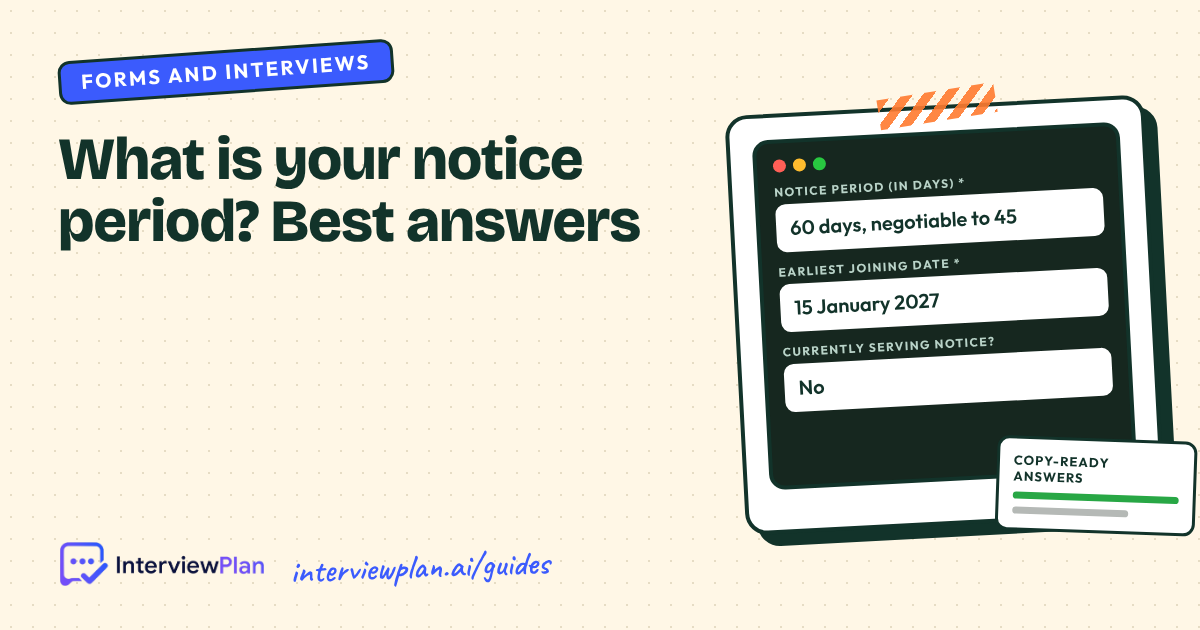
Give your contractual notice period as a number, then any flexibility. On a form, write "60 days" or "30 days, negotiable". In an interview, say: "My notice period is 60 days. I can try to bring it down to 45 if needed." If you are not employed, say "Immediately available". Never shorten the number to look better. Employers check.
Copy-ready answers for application forms
Find your situation and copy the line.
Your situation | What to write in the form |
|---|---|
Standard notice | 60 days |
Standard notice, some flexibility | 60 days, negotiable to 45 |
Notice with buyout option | 90 days, buyout possible |
Already resigned, serving notice | Serving notice, last working day 15 January 2027 |
Not working right now | Immediately available |
Fresher or student | Available from [date you finish your course] |
Contract or freelance | 2 weeks |
Form asks for days only | 60 |
Form asks for earliest joining date | 15 January 2027 |
If the field accepts a number only, type the number of days, such as 60. If it asks for weeks, convert: 30 days is about 4 weeks.
How to answer in an interview
Keep it to two sentences: the fact, then the flexibility.
Standard notice:
"My notice period is 60 days. If the timing is important, I can speak to my manager about an early release, and I'd expect to be able to join in about 45 days."
90 days, with a buyout option:
"My contractual notice is 90 days. My company does allow a buyout, so if you need me sooner, that's something we could discuss."
Serving notice:
"I've already resigned and I'm serving my notice. My last working day is 15 January, so I can join any time after that."
Immediate joiner:
"I'm available to join immediately."
If you were laid off, you don't need to explain on the form. If it comes up in the interview, be brief and factual. See how to talk about a layoff in an interview.
Fresher:
"I finish my final exams on 20 May, so I can join from 1 June."
"If you are successful in this role, what would be your notice period?"
This is the same question, asked politely. Answer with the number and the date you could start:
"My notice period is 30 days, so if I resigned at the offer stage, I could start in early January."
Notice periods are different by country
Country | Common practice | How to answer |
|---|---|---|
United States | Most jobs are at-will. Two weeks' notice is a common courtesy, not a legal rule | "Two weeks" |
Canada | Depends on the province and the contract. Two weeks is common for employees | "Two weeks" or what your contract says |
United Kingdom | Contractual. One month is common, and longer for senior roles | "One month", or what your contract says |
India | Contractual. 30 to 90 days is common in IT, and buyouts are often possible | "60 days, negotiable" |
These are common patterns, not legal advice. Your employment contract decides your real notice period.
What not to say
A shorter number than your contract. Background checks and relieving letters reveal the real one. It can cost you the offer.
"I'll just leave." Walking out without serving notice tells the new employer you'd do the same to them.
A long story. The interviewer wants a number and a date.
"Whatever you need." Promise only what your current employer will actually allow.
Should you negotiate your notice period?
Yes, but in the right order:
Get the offer first, in writing, with the joining date.
Ask your current manager about an early release, offering a clean handover.
If they say no, ask the new employer whether they'll pay for a buyout. Our full guide: how to negotiate a notice period buyout.
Use unused earned leave to shorten your notice only if your policy allows it, and get that in writing.
Timing your resignation at year end
If you're deciding between resigning now and resigning in January, bonuses, vesting dates and gratuity can change the answer. See resign in December or January?
Related questions
Want to practise saying it out loud? Try the screening-call questions in an AI mock interview.
FAQ
1. What should I write as my notice period?
Mention your actual contractual notice period, such as 30, 60 or 90 days.
2. What if I can join immediately?
Write "Immediately available" if you are currently not employed and ready to start.
3. Can I negotiate my notice period?
Yes. You can request an early release or discuss a notice period buyout with your current employer.
4. Should I mention that my notice period is negotiable?
Yes, if flexibility is possible. For example: "60 days, negotiable to 45 days."
5. What is the typical notice period in India?
Notice periods of 30, 60 and 90 days are common, depending on company policy and your employment contract.
6. What if my new employer needs me to join sooner?
Discuss an early release with your current employer and communicate your realistic joining date.
7. What should freshers write as their notice period?
Freshers who are not employed can write "Immediately available" or mention their expected graduation date.
8. What if I am already serving my notice period?
Mention your confirmed last working day so recruiters know when you can join.